Product List
Gangsteel Material Solution
Email: admin@gangsteel.com
Sales: jack@gangsteel.com
EN 10025-3 S275N steel plate is a low-alloy, fine-grained structural steel designed for weldable applications in moderate-temperature environments. It conforms to the European standard EN 10025-3, specifying technical delivery conditions for normalized/normalized rolled weldable fine grain structural steels. The typical delivery condition is normalized or normalized rolled, which refines the microstructure for improved toughness and uniformity.
The designation "EN 10025-3 S275N" means:
As a fine grain structural steel, EN 10025-3 S275N achieves controlled grain size for better impact resistance, weldability, and formability, making it a versatile choice for general construction projects.
Browse our extensive collection of EN 10025-3 normalized steel plates to find the perfect fit.
EN 10025-3 S275N's composition is optimized for balanced strength and fabricability, featuring low carbon and alloy content to enhance weldability and reduce susceptibility to cracking.
Here's a table showing the ladle analysis (during melting) and product analysis (finished plate) as per EN 10025-3:
|
Element |
Ladle Analysis |
Product Analysis |
|---|---|---|
|
Carbon (C) |
max 0.18% |
max 0.20% |
|
Silicon (Si) |
max 0.40% |
max 0.50% |
|
Manganese (Mn) |
0.50-1.50% |
0.45-1.60% |
|
Phosphorus (P) |
max 0.025% |
max 0.035% |
|
Sulfur (S) |
max 0.015% |
max 0.025% |
|
Nitrogen (N) |
max 0.012% |
max 0.014% |
|
Aluminum (Al) |
min 0.02% (total) |
min 0.015% (total) |
|
Niobium (Nb) |
max 0.05% |
max 0.06% |
|
Vanadium (V) |
max 0.05% |
max 0.07% |
|
Titanium (Ti) |
max 0.05% |
max 0.06% |
The Carbon Equivalent (CEV) uses the formula: CEV = C + Mn/6 + (Cr + Mo + V)/5 + (Ni + Cu)/15. For EN 10025-3 S275N, CEV ≤0.40% (up to 63 mm thickness), confirming its excellent weldability for routine processes without excessive precautions.
EN 10025-3 S275N offers reliable mechanical characteristics, including a minimum yield strength of ≥275 MPa, tensile strength of 370-510 MPa, and elongation ≥23-24%. It demonstrates solid impact toughness of ≥27 J at -20°C (Charpy V-notch, longitudinal).
Properties scale with thickness; consult this table:
|
Thickness (mm) |
Yield Strength (min, MPa) |
Tensile Strength (MPa) |
Elongation (min, %) |
Impact Energy (min, J @ -20°C, Longitudinal) |
|---|---|---|---|---|
|
≤16 |
275 |
370-510 |
24 |
27 |
|
16<t≤40 |
265 |
370-510 |
24 |
27 |
|
40<t≤63 |
255 |
370-510 |
24 |
27 |
|
63<t≤80 |
245 |
370-510 |
23 |
27 |
|
80<t≤100 |
235 |
370-510 |
23 |
27 |
|
100<t≤150 |
225 |
350-480 |
23 |
27 |
|
150<t≤200 |
215 |
350-480 |
23 |
27 |
|
200<t≤250 |
205 |
350-480 |
23 |
27 |
These specs support its role in moderately demanding structural roles.
EN 10025-3 S275N matches several worldwide standards, with potential minor deviations:
|
Standard |
Equivalent Steel Grade |
|---|---|
|
EN (Thermo-mechanical) |
S275M |
|
EN normalized + low temp |
S275NL |
|
DIN |
StE 275 / TStE 275 |
|
AFNOR (France) |
E 28-2 |
|
BS (UK) |
43 EE |
|
UNI (Italy) |
Fe E 275 KNR |
|
GB (China) |
Q275N |
|
ASTM / ASME |
A572 Grade 50 (approximate) |
For enhanced low-temperature capability, see our EN 10025-3 S275NL normalized structural steel plate.
These distinctions help tailor material choices:
Considerations include temperature exposure, cost, and fabrication ease.
With its low CEV, EN 10025-3 S275N welds effortlessly using GMAW or SAW, adhering to EN 1011-2 standards.
Preferred fillers:
This promotes durable, defect-free welds.
EN 10025-3 S275N serves industries seeking economical, reliable performance:
Choose EN 10025-3 S275N for its affordable strength, -20°C impact resistance, and easy weldability, meeting Eurocode 3 for everyday engineering.
Related grades: Our EN 10025-3 S275N normalized structural steel plate or EN 10025-3 S355NL normalized structural steel plate.
Gangsteel provides EN 10025-3 S275N in adaptable dimensions:
Offered in hot-rolled and normalized state, complete with EN 10204 3.1/3.2 certificates and UT testing (EN 10160) as needed. Priming options for surface protection.
As expert producers and exporters, Gangsteel delivers superior EN 10025-3 S275N:
Value-added: Cutting, welding, bending. Supplied with mill test reports and ABS/LR/BV/DNV certifications.
Inquire for EN 10025-3 S275N normalized structural steel plate.
Is EN 10025-3 S275N steel good for welding?Yes; CEV ≤0.40% allows simple arc welding with no special requirements.
What temperature can EN 10025-3 S275N be used in?Suitable from -20°C to +400°C, with verified toughness at -20°C; opt for S275NL below that.
Does EN 10025-3 S275N require preheating when welding?No for thin sections (≤20 mm); light preheat (50-100°C) for thicker to ensure quality.
Is EN 10025-3 S275N equivalent to ASTM A572?Approximate to A572 Grade 50 (yield ~345 MPa equivalent), but EN 10025-3 S275N's normalization adds superior toughness; not a perfect match.
What is the maximum thickness available for EN 10025-3 S275N?Reaches 250 mm, with properties tapered for thicker plates to uphold standards.
Can EN 10025-3 S275N be used in construction in temperate climates?Ideal; its balanced properties suit bridges, buildings, and machinery in regions above -20°C.
What is the difference between EN 10025-3 S275N and EN 10025-2 S275JR?EN 10025-3 S275N is normalized fine-grain for -20°C impact, while S275JR (EN 10025-2) is basic hot-rolled without low-temp guarantees.
How does EN 10025-3 S275N compare to Chinese Q275N?Q275N is a near-equivalent with matching strength and -20°C performance, but EN 10025-3 S275N ensures stricter EU controls on composition and testing.
Discover more via EN 10025-3 S420N normalized structural steel plate or EN 10025-3 S275NL normalized structural steel plate.
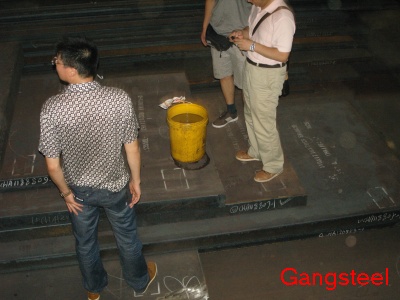
EN 10025-3 S355N steel plate is a medium-strength, fine-grained structural steel designed for weldable applicat
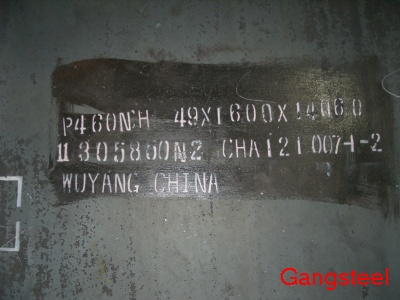
EN 10025-3 S355NL steel plate is a medium-strength, fine-grained structural steel tailored for weldable use in
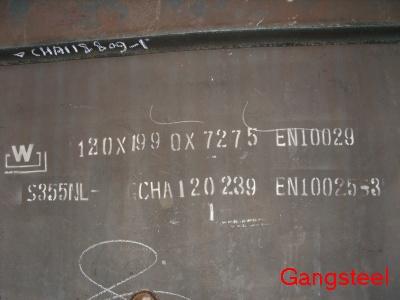
EN 10025-3 S420NL steel plate is a high-strength, fine-grained structural steel designed for weldable applicati
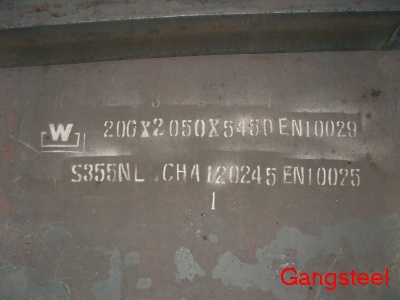
EN 10025-3 S460NL steel plate is a high-strength, fine-grained structural steel optimized for weldable applicat


