


What grade of steel is EN 10025-2? EN 10025-2 is not a single grade. It is the European standard for hot-rolled non-alloy structural steels in grades S235, S275, S355 and S450, where the number is the minimum yield in MPa (t ≤ 16 mm). Suffixes give the Charpy test: JR = 27 J at +20°C, J0 = 27 J at 0°C, J2 = 27 J at −20°C and K2 = 40 J at −20°C. S355J2 and S275JR are the most widely used.
Gangsteel, a steel plate exporter, supplies EN 10025-2 plates in all of these grades.
EN 10025-2 ladle analysis, % max (t ≤ 16 mm)
| Grade | C | Si | Mn | P | S | N | Cu | CEV (t≤30) |
|---|---|---|---|---|---|---|---|---|
| S235JR | 0.17 | – | 1.40 | 0.035 | 0.035 | 0.012 | 0.55 | 0.35 |
| S235J2 | 0.17 | – | 1.40 | 0.025 | 0.025 | – | 0.55 | 0.35 |
| S275JR | 0.21 | – | 1.50 | 0.035 | 0.035 | 0.012 | 0.55 | 0.40 |
| S275J2 | 0.18 | – | 1.50 | 0.025 | 0.025 | – | 0.55 | 0.40 |
| S355JR | 0.24 | 0.55 | 1.60 | 0.035 | 0.035 | 0.012 | 0.55 | 0.45 |
| S355J2/K2 | 0.20 | 0.55 | 1.60 | 0.025 | 0.025 | – | 0.55 | 0.45 |
| S450J0 | 0.20 | 0.55 | 1.70 | 0.030 | 0.030 | 0.025 | 0.55 | 0.47 |
Source: EN 10025-2:2004 Tables 2 and 6. S185 has no chemical requirements. The standard also gives product analysis limits (Table 3), e.g. S355J2: C 0.23, Si 0.60, Mn 1.70, P/S 0.035, Cu 0.60.
EN 10025-2 product analysis, % max (t ≤ 16 mm)
| Grade | C | Si | Mn | P | S | N | Cu |
|---|---|---|---|---|---|---|---|
| S235JR | 0.19 | – | 1.50 | 0.045 | 0.045 | 0.014 | 0.60 |
| S235J2 | 0.19 | – | 1.50 | 0.035 | 0.035 | – | 0.60 |
| S275JR | 0.24 | – | 1.60 | 0.045 | 0.045 | 0.014 | 0.60 |
| S275J2 | 0.21 | – | 1.60 | 0.035 | 0.035 | – | 0.60 |
| S355JR | 0.27 | 0.60 | 1.70 | 0.045 | 0.045 | 0.014 | 0.60 |
| S355J2/K2 | 0.23 | 0.60 | 1.70 | 0.035 | 0.035 | – | 0.60 |
| S450J0 | 0.23 | 0.60 | 1.80 | 0.040 | 0.040 | 0.027 | 0.60 |
Source: EN 10025-2:2004, Table 3 (chemical composition of the product analysis).
Related: S235JR plate, S275JR plate, S355J2 plate.
EN 10025-2 is a European standard that defines the technical delivery conditions for hot-rolled non-alloy structural steels, which are commonly used in construction, bridges, machinery, and other load-bearing applications. It is part of the broader EN 10025 series, which covers various types of structural steels with different properties like yield strength, toughness, and corrosion resistance. EN 10025-2 specifically focuses on non-alloy steels, meaning they are primarily carbon-based without significant alloying elements like chromium or nickel. The standard ensures consistent quality, weldability, and performance across Europe, facilitating trade and engineering reliability.
The grades in EN 10025-2 are designated based on their minimum yield strength and impact toughness. The "S" prefix stands for structural steel, followed by the yield strength value (e.g., 235, 275), and a suffix indicating toughness level (e.g., JR for 27 J at +20°C). These grades are suitable for welded, bolted, and riveted structures, with applications ranging from buildings to offshore platforms. Below, we detail the main grades, their properties, and equivalent materials, helping engineers select the appropriate grade for specific projects. Our team offers all EN 10025-2 grades, including EN 10025-2 S355JR steel and EN 10025-2 S355J2 steel, with customization options.
Main Grades in EN 10025-2
EN 10025-2 includes 12 primary grades, categorized by yield strength levels: S185, S235, S275, S355, and S450. Each group has sub-grades based on impact toughness: JR ( +20°C), J0 (0°C), J2 (-20°C), and K2 (-20°C with higher energy). The table below lists the grades with their minimum yield strength (for plates up to 16 mm thick) and impact toughness requirements:
|
Grade |
Minimum Yield Strength (MPa) |
Tensile Strength (MPa) |
Impact Toughness (min J / °C) |
Key Applications |
|---|---|---|---|---|
|
S185 |
185 |
310–540 |
Not specified |
Basic low-strength structures, e.g., light frames. |
|
S235JR |
235 |
360–510 |
27 J at +20°C |
General construction, buildings, and welded assemblies. |
|
S235J0 |
235 |
360–510 |
27 J at 0°C |
Moderate cold environments, e.g., machinery parts. |
|
S235J2 |
235 |
360–510 |
27 J at -20°C |
Low-temperature structures, e.g., offshore platforms. |
|
S275JR |
275 |
410–560 |
27 J at +20°C |
Bridges, buildings, and load-bearing frames. |
|
S275J0 |
275 |
410–560 |
27 J at 0°C |
Cranes and equipment in cool climates. |
|
S275J2 |
275 |
410–560 |
27 J at -20°C |
Cold-weather construction, e.g., arctic infrastructure. |
|
S355JR |
355 |
470–630 |
27 J at +20°C |
High-rise buildings and heavy bridges. |
|
S355J0 |
355 |
470–630 |
27 J at 0°C |
Wind turbines and moderate-cold machinery. |
|
S355J2 |
355 |
470–630 |
27 J at -20°C |
Offshore rigs and cold-climate structures. |
|
S355K2 |
355 |
470–630 |
40 J at -20°C |
Extreme toughness applications, e.g., seismic zones. |
|
S450J0 |
450 |
550–720 |
27 J at 0°C |
High-strength machinery and load-bearing equipment. |
These grades are non-alloy, meaning they rely on carbon and manganese for strength rather than expensive alloys. Yield strength decreases for thicker plates (e.g., S355JR drops to 345 MPa for 16–40 mm). Our team provides all grades with CE marking and EN 10204 certification for compliance.
Chemical Composition Requirements for EN 10025-2 Grades
The chemical composition in EN 10025-2 is controlled to ensure weldability and toughness, with limits on carbon, manganese, and impurities. The table below shows maximum values for key elements in selected grades (for plates up to 16 mm thick):
Low P and S improve toughness, while Mn boosts strength. Our team ensures precise composition for optimal performance, with options for low-alloy variants.
Mechanical Properties of EN 10025-2 Grades
Mechanical properties vary by grade and thickness, with yield strength decreasing for thicker plates. The table below shows minimum yield strength (ReH in MPa) for different thickness ranges, as per EN 10025-2:
|
Grade |
t ≤ 16 mm |
16 < t ≤ 40 mm |
40 < t ≤ 63 mm |
63 < t ≤ 80 mm |
80 < t ≤ 100 mm |
100 < t ≤ 150 mm |
150 < t ≤ 200 mm |
200 < t ≤ 250 mm |
|---|---|---|---|---|---|---|---|---|
|
S235JR |
235 |
225 |
215 |
215 |
215 |
195 |
185 |
175 |
|
S275JR |
275 |
265 |
255 |
245 |
235 |
225 |
215 |
205 |
|
S355JR |
355 |
345 |
335 |
325 |
315 |
295 |
285 |
275 |
|
S450J0 |
450 |
430 |
410 |
390 |
380 |
380 |
- |
- |
Tensile strength for S235 is 360–510 MPa, S275 410–560 MPa, S355 470–630 MPa, and S450 550–720 MPa. Elongation is typically 20–26%, depending on grade and thickness. Impact toughness for JR is 27 J at +20°C, J0 at 0°C, J2 at -20°C, and K2 40 J at -20°C.
Weldability and Fabrication of EN 10025-2 Steels
EN 10025-2 steels have excellent weldability due to low carbon equivalents (CEV max 0.35–0.45 depending on grade). They are compatible with SMAW, GTAW, and SAW, with no preheating needed for plates up to 25 mm in most cases. For thicker plates or low-temperature grades (J2/K2), preheating to 100–150°C reduces cracking risk.
Fabrication includes good machinability and formability, with normalized conditions for higher grades like S355J2 improving toughness. Our team offers cut-to-size and beveling for efficient fabrication.
Equivalents and Comparisons
EN 10025-2 grades have equivalents in other standards:
- S235JR: ASTM A283 Gr C, DIN ST37-2, JIS SS400.
- S275JR: ASTM A36, DIN ST44-2, JIS SS400.
- S355JR: ASTM A572 Gr 50, DIN ST52-3, JIS SM490A.
- S450J0: ASTM A572 Gr 65, DIN ST52-3 (higher strength variant).
S235 grades are entry-level for low loads, S275 for moderate, S355 for high, and S450 for heavy-duty. For more details, refer to our EN 10025-2 S355JR+N or EN 10025-2 S355K2 steel offerings.
Why Choose Us for EN 10025-2 Steels?
Our team is a trusted supplier of EN 10025-2 grades, offering:
- Certified Quality: Plates undergo ultrasonic testing, Charpy impact tests, and chemical analysis to meet EN 10025-2 standards.
- Customization: Available in thicknesses from 6–300 mm, with options for normalization, cut-to-size, and beveling.
- Global Supply: Competitive pricing and reliable delivery from China to worldwide markets.
- Technical Support: Guidance on selecting grades like EN 10025-2 S355J0 or EN 10025-2 S235J2 steel.
Summary
This article details the grades of EN 10025 steel across its six parts, listing key grades with their yield strengths, tensile properties, and applications. It covers non-alloy, fine grain, weathering, and high-strength steels for construction and engineering.
EN 10025-2 Steel Grades FAQ
What is EN 10025-2 steel?
It is the European standard (Part 2 of EN 10025) for hot-rolled non-alloy structural steels, covering plates, sections, bars and wide flats.
What is the difference between EN 10025-2 and EN 10025-3?
Part 2 covers non-alloy steels (S235–S450); Part 3 covers normalized fine-grain steels such as S355N and S355NL; Part 4 covers thermomechanically rolled steels such as S355M.
What is EN 10025-2 S355JR equivalent to?
Roughly ASTM A572 Grade 50 or A709 Grade 50, old DIN St52-3 (St52-2) and GB Q355B.
What does J2 mean in steel grades?
J2 means a minimum Charpy V impact energy of 27 J at −20°C.
What is the strongest grade in EN 10025-2?
S450J0, with 450 MPa minimum yield and 550–720 MPa tensile, tested at 0°C.
Is EN 10025-2 the same as EN 10025?
EN 10025-1 gives general delivery conditions; Part 2 is the non-alloy product part, so 'EN 10025 S355' normally means EN 10025-2.
Which EN 10025-2 grade is equivalent to ASTM A36?
S235JR is lower and S275JR is slightly higher than A36; S275JR is the usual substitute.
-

BHW35 Steel Plate for Sale | RF
BHW35 / 13MnNiMo5-4 (DIWA 353 family): identity, chemistry, mechanical properties, related grades, and RFQ note
-
ASTM A516 Grade 70 Equivalent:
ASTM A516 Grade 70 equivalents include ASME SA516 Gr 70, EN 10028-2 P355GH and BS 1501 224-490. Gangsteel compa
-
What is the difference between
we supply high-quality A516 Gr 70 steel plate for pressure vessel applications and other standards like ASTM A2
-
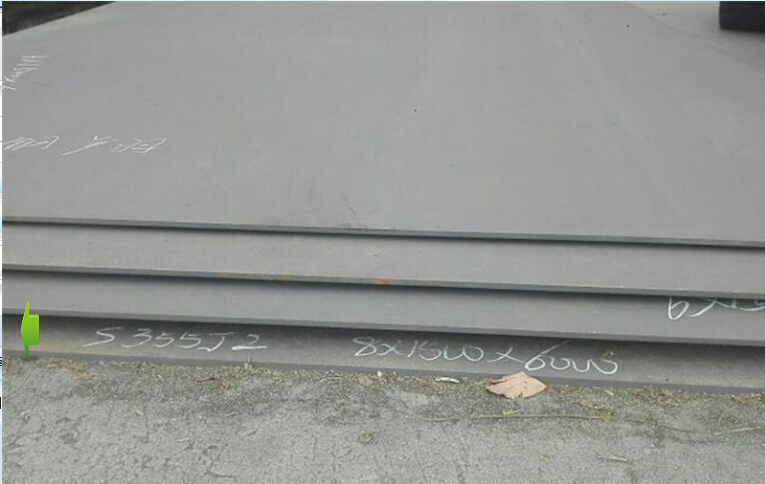
P355GH AND S355J2 Steel Plates
EN10028-2 P355GH for High-Strength Low-Alloy Columbium-Vanadium Structural Steel EN10025-2 S355J2 Structural St