


API 5L Steel Plate
API 5L X100 Line Pipe: Grades, Chemistry and Properties
API 5L X100 — also written X100 line pipe, L690 and API Spec 5L X100 — is a finished-pipe designation. Gangsteel separates starting flat material from pipe certification when reviewing enquiries, and checks the specified edition, product specification level and manufacturing route before quoting.
Edition boundary: numerical tables on this page use API Spec 5L, 46th edition (April 2018). API published the 47th edition on 2 June 2026. The older numerical tables are identified for legacy-contract comparison and must not be presented as verified 47th-edition requirements. State the governing edition on the order. API 5L specifies finished line pipe, not a stand-alone plate product.
What Is API 5L X100?
X100 / L690 is one of the explicitly tabulated high-strength PSL 2 pipe grades in the 46th edition. The standard lists an M thermomechanically rolled route for welded pipe and a Q quenched-and-tempered route restricted to seamless pipe.
| Steel name | PSL | Condition / route |
|---|---|---|
| L690M / X100M | PSL 2 | Thermomechanically rolled; welded pipe |
| L690Q / X100Q | PSL 2 | Quenched and tempered; seamless only |
Chemical Composition: Heat and Product Analyses
| Condition | C | Si | Mn | P | S |
|---|---|---|---|---|---|
| X100M / L690M | 0.10 | 0.55 | 2.10 | 0.020 | 0.010 |
| X100Q / L690Q | 0.16 | 0.45 | 1.90 | 0.020 | 0.010 |
The table is explicitly based on heat and product analyses. For the M row, the Si and Mn values are subject to the standard’s “unless otherwise agreed” qualification. For the Q row, where present, that qualification applies to C and Si. Unless otherwise agreed, Nb + V + Ti ≤0.15%. Do not turn this combined limit into three independent element maxima.
| Condition | Residual/alloy limits unless otherwise agreed | Carbon equivalent |
|---|---|---|
| X100M | Cu ≤0.50; Ni ≤1.00; Cr ≤0.50; Mo ≤0.50 | CE Pcm ≤0.25 |
| X100Q | Cu ≤0.50; Ni ≤1.00; Cr ≤0.55; Mo ≤0.80 | CE limits as agreed |
B ≤0.004% for the listed grade condition(s). Product-analysis CE Pcm is C + Si/30 + (Mn + Cu + Cr)/20 + Ni/60 + Mo/15 + V/10 + 5B. The 0.25 maximum is not a universal IIW carbon-equivalent limit. Thicker-wall chemistry is agreed rather than extrapolated from the t ≤25 mm table.
Mechanical Properties of Finished Pipe
| Property | M condition / Q condition | Qualification |
|---|---|---|
| Yield strength | 690–840 MPa | Rp0.2 |
| Tensile strength | 760–990 MPa | Pipe body |
| Yield / tensile ratio maximum | 0.97 | Applies for D >323.9 mm; lower values may be agreed where specified |
| Weld-seam tensile minimum, welded M pipe | 760 MPa | Applicable seam tensile test |
| Elongation | Table 7 specimen-area formula | Not a fixed percentage for all pipe sizes |
For SI calculations, the elongation expression is Af = 1940 × Axc^0.2 / U^0.9, with Axc the applicable test-piece cross-sectional area in mm² and U the specified minimum tensile strength in MPa. The standard defines the specimen-dependent area and rounding rules. Charpy, DWTT, seam testing and any special-service annex requirements must be selected for the actual pipe size and contract; a strength grade alone does not define them.
Delivery Condition and Process Parameters
M delivery obtains its property balance through controlled thermomechanical processing. Q delivery obtains the final properties by quenching and tempering the seamless pipe. Neither route gives a universal field heat-treatment cycle. Subsequent hot bending, stress relief or welding must be assessed against the qualified pipe procedure.
| Parameter | Requirement |
|---|---|
| Permitted steel names | X100M, X100Q |
| M route | Thermomechanically rolled welded pipe |
| Q route | Seamless only |
| Chemistry-table thickness | t ≤25.0 mm |
| Y/T ratio diameter threshold | D >323.9 mm |
| Thermal cycle | Manufacturer-qualified; not a single universal furnace schedule |
X100 is used as a high-strength line-pipe selection candidate, not as evidence of guaranteed plate stock or a completed pipeline design. Qualify forming, seam welding, girth welding and fracture-control requirements together. Use actual heat chemistry, thickness, restraint and consumables to establish a welding procedure; do not prescribe preheat from the X-number alone.
Equivalent Designations and Engineering Substitution
L690 is the paired SI designation within this edition of API 5L for X100. It is not a declaration of equivalence to a structural plate or another pipe standard. Compare product form, delivery condition, chemistry, tensile test basis, toughness, inspection and the governing edition before accepting an alternative. A plate or coil certificate cannot replace the finished-pipe test record.
Applications, Fabrication and Ordering
Finished pipe is ordered for the intended transportation service and project design. When the enquiry is for plate or strip intended for welded-pipe production, state that scope explicitly and agree starting-material properties, tolerances, edge preparation and inspection. The pipe producer remains responsible for qualifying the finished-pipe route. Service suitability, including any sour-service or low-temperature requirements, is assessed separately from the base grade.
Frequently Asked Questions
Is API 5L X100 a finished steel plate grade?
No. API 5L X100 is a line-pipe designation. Starting plate or strip can be procured for a pipe-making route only under an explicit material specification. It does not become finished certified pipe before forming, welding where relevant and pipe testing.
Which edition supplies the numerical data on this page?
The tables are explicitly based on API Spec 5L, 46th edition, April 2018. API published the 47th edition in June 2026. Use the edition named in the purchase order and do not assume these older figures have been verified against the newer text.
What does L690 mean?
L690 is the paired SI steel designation for X100 in the stated edition. For PSL 2, the condition letter remains part of the steel name. A matching strength designation does not remove the need to specify route, dimensions and inspection.
Is X100 available as PSL 1 and PSL 2?
This high-strength grade is listed under PSL 2 in the 46th-edition base table, not PSL 1. A web reference to a PSL 1 version is not evidence of a tabulated standard grade.
Can one elongation percentage be used for every pipe size?
No. The applicable tensile table calculates minimum elongation from the defined specimen area and specified minimum tensile strength. Test-piece geometry and the standard’s calculation rules must be identified before comparing results.
Can the chemistry table be extended to thicker walls?
Not by simple extrapolation. The quoted chemistry tables are for t ≤25.0 mm. For greater wall thickness, use the contract edition’s agreement provisions and the qualified manufacturing route rather than inventing a wider guaranteed range.
Does the designation guarantee HIC, SSC or offshore qualification?
No. Additional service conditions, annex provisions and project tests must be invoked explicitly. Base-grade tensile and chemistry data alone do not establish sour-service or offshore acceptance.
How should an enquiry for X100 be written?
State API Spec 5L, its edition, X100 / L690, PSL, condition where applicable, pipe route, outside diameter, wall thickness, lengths, ends, coating and inspection requirements. Identify whether the purchase is finished pipe or starting flat material. Lead time is confirmed from the actual enquiry.
Related: API 5L grade overview · Pipeline products
For an enquiry, state the complete material designation and edition, product form, dimensions, quantity, inspection document, testing options, packing and destination. Availability and delivery time are confirmed against the actual enquiry; this page is not an inventory or lead-time guarantee.
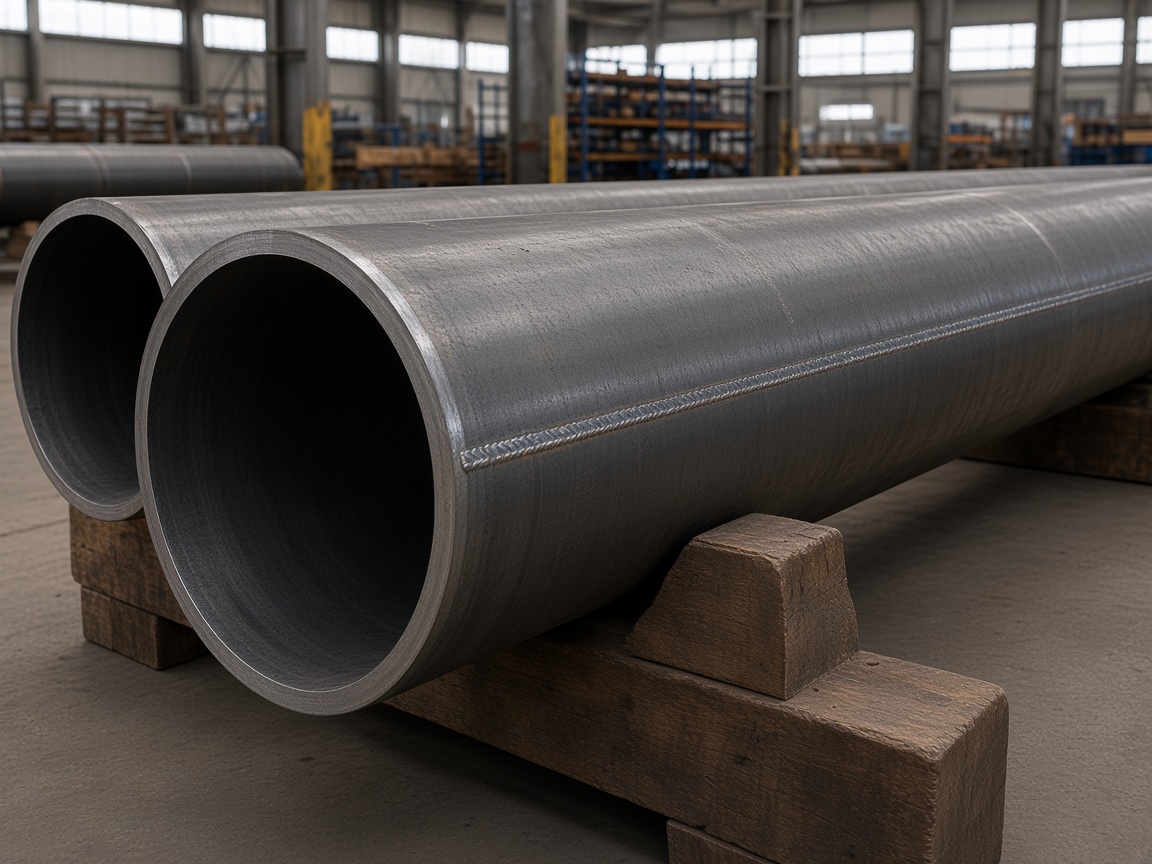
The original generated product-form image is illustrative. Appearance does not identify a steel grade or prove certification.
-

API 5L X70|X70 STEEL PLATE
Gangsteel is specialized in supplying API 5L steel plate in X70,API X70,API 5L X70.