


EN 10208-2 Line Pipe
EN 10208-2 L290NB Line Pipe: Chemistry and Properties
L290NB — also written L290NB, EN 10208-2 L290NB, steel number 1.0484, L 290 NB — is a 290 MPa minimum-yield line-pipe grade. Gangsteel reviews L290NB enquiries by pipe route, wall thickness and the original contract edition, rather than treating the strength number as a free-standing steel-plate specification.
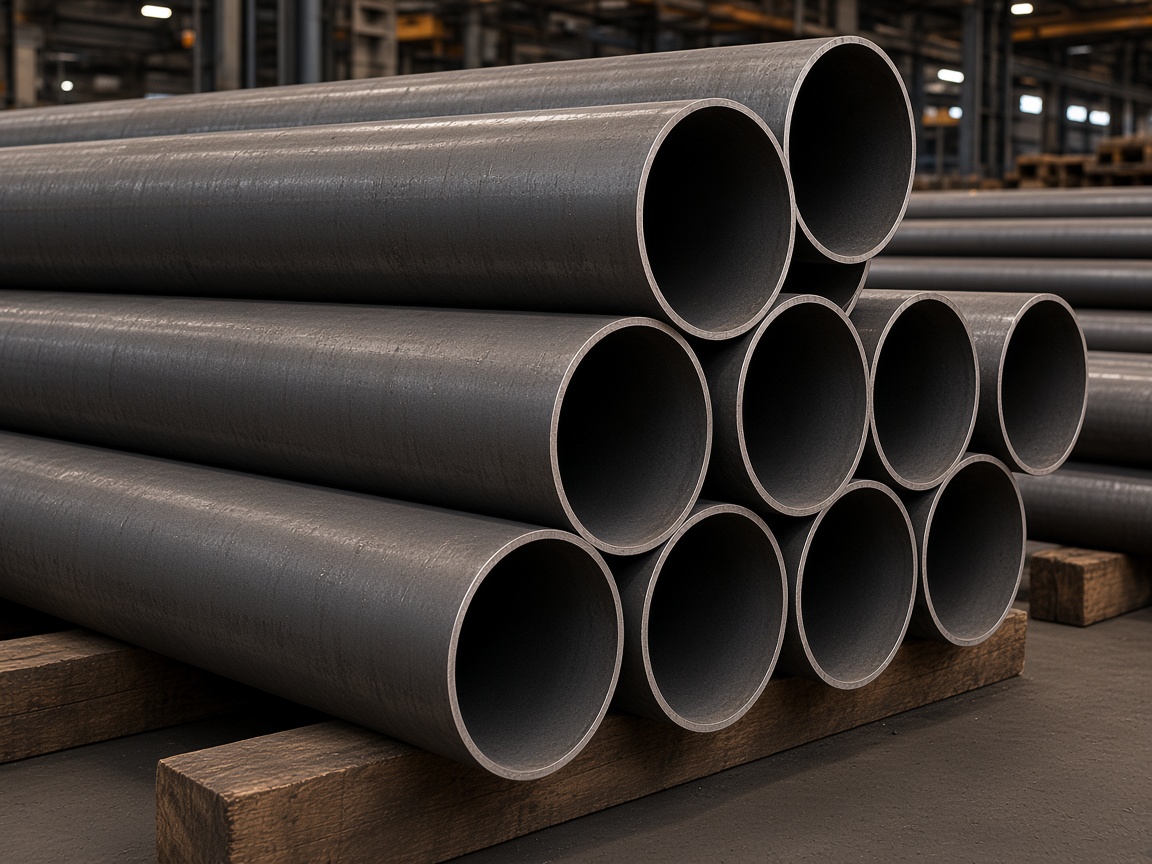
Edition and product boundary: the numerical requirements below are from EN 10208-2:2009, a superseded line-pipe standard for requirement class B. It was replaced in the UK by BS EN ISO 3183:2012. They are legacy-contract data, not a claim that EN 10208-2 is the current edition or a finished steel plate standard. Starting plate or strip must be specified separately; pipe acceptance follows pipe manufacture and testing.
Designation and Manufacturing Route
The number 290 identifies the specified minimum yield strength in MPa. In this designation, N describes the processing condition and the final B identifies requirement class B. The route is normalized or normalizing-formed; seamless and welded routes are listed. A change in suffix is a change in the specified material, not a spelling variation.
| Item | Requirement |
|---|---|
| Grade / steel number | L290NB / 1.0484 |
| Reference edition | EN 10208-2:2009 |
| Numerical chemistry and tensile table scope | Pipe wall thickness T ≤ 25 mm |
| Above 25 mm up to 40 mm | Composition and mechanical properties are agreed at enquiry/order |
| Delivery condition | normalized or normalizing-formed; seamless and welded routes are listed |
L290NB Chemical Composition
| Element | Cast-analysis limit |
|---|---|
| C | .17 |
| Si | .40 |
| Mn | 1.20 |
| P | 0.025 |
| S | 0.020 |
| V | .05 |
| Nb | .05 |
| Ti | .04 |
These are cast-analysis limits, not nominal melt targets. For each reduction of 0.01 percentage point below the maximum carbon, manganese may increase by 0.05 percentage point above its tabulated maximum, with a maximum increase of 0.20 percentage point. Unlisted intentional alloy additions require purchaser approval, except the permitted deoxidizing and finishing additions.
| Control | Limit |
|---|---|
| Al total | 0.015 ≤ Al < 0.060 |
| N | ≤0.012 |
| Al/N | ≥2 |
| Cu | ≤0.25 |
| Ni | ≤0.30 |
| Cr | ≤0.30 |
| Mo | ≤0.10 |
| CEV, product analysis only | ≤.42 |
CEV is calculated as C + Mn/6 + (Cr + Mo + V)/5 + (Ni + Cu)/15. Do not compare a heat-analysis CEV with a limit explicitly defined for product analysis.
| Element | Permissible deviation |
|---|---|
| C | +0.02 |
| Si | +0.05 |
| Mn | +0.10 |
| P | +0.005 |
| S | +0.005 |
| V | +0.01 |
| Nb | +0.01 |
| Ti | +0.01 |
| Cr | +0.05 |
| Ni | +0.05 |
| Mo | +0.03 |
| Cu | +0.05 |
| Al | ±0.005 |
| N | +0.002 |
The deviations are product-check tolerances, not permission to raise the specified heat-analysis limits. The Table 4 deviation for a specified V + Nb + Ti sum of 0.15% maximum is +0.02 percentage point. Apply each deviation only where the corresponding composition limit is specified.
L290NB Mechanical Properties
| Test | Value | Basis |
|---|---|---|
| Yield strength Rt0.5 | 290–440 MPa | Finished pipe |
| Tensile strength Rm | ≥415 MPa | Also applies to the weld seam where applicable |
| Elongation A | ≥21% | Transverse pipe-body specimen |
| Longitudinal elongation A | ≥23% | Where a longitudinal specimen is used under Table 18 |
The tabulated strength and elongation values apply to the pipe, not automatically to the starting coil or plate. Charpy requirements are selected using the specified safety-factor table, outside diameter, wall thickness, orientation and specimen size. A single universal impact-energy number would hide those conditions and is not used here. The hydrostatic test and applicable seam/body non-destructive testing remain part of pipe acceptance.
Delivery Condition and Heat Treatment
L290NB is ordered in the normalized or normalizing-formed condition. The manufacturing procedure must deliver the specified pipe properties after forming, welding where relevant and sizing. A plate certificate alone cannot establish that the finished pipe complies.
| Parameter | Control |
|---|---|
| Condition symbol | N |
| Numerical wall-thickness basis | T ≤25 mm |
| Higher-thickness agreement | 25 < T ≤40 mm |
| Cold sizing ratio without subsequent full heat treatment | Not more than 0.015 under clause 7.5 |
| Heating cycle | Qualified by the pipe manufacturer; no single universal furnace setpoint is prescribed in this summary |
For quenched-and-tempered or thermomechanically rolled pipe, subsequent hot forming or field heat treatment can adversely change the properties. Obtain the manufacturer’s processing limits before using a stress-relieving or hot-bending cycle. The condition letter must remain consistent across the order, certificate and finished-pipe records.
Equivalent Grades and Substitution
1.0484 is the steel number for L290NB in this edition, not a different international specification. A grade with the same minimum yield strength under API 5L or ISO 3183 is only a comparison candidate: chemistry, delivery route, toughness, test location and inspection differ. Substitution needs the project engineer’s written acceptance and a clause-by-clause comparison.
Applications, Welding and Inspection
L290NB is considered for class-B pipeline enquiries involving combustible-fluid transport when the project explicitly invokes the legacy standard. At 290 MPa minimum yield strength, pipe diameter, wall thickness, fracture control and weld qualification must be considered together; the strength number alone does not establish design pressure. Use the actual heat chemistry and agreed CEV when qualifying preheat and consumables. Preserve heat-to-pipe traceability when cutting test pieces or field lengths.
Specify whether the purchase is for finished pipe or starting flat material. For welded-pipe starting material, agree plate/strip tolerances, edge condition, lamination testing, sampling and the intended forming route. For finished pipe, define end preparation, coating, inspection documentation and the applicable destructive and non-destructive testing. Neither route is described here as automatically HIC-resistant or sour-service qualified.
Frequently Asked Questions
Is L290NB a steel plate specification?
No. L290NB belongs to EN 10208-2:2009 for finished line pipe. A flat starting product can be engineered for a pipe-making route, but it needs an explicit material order and cannot inherit finished-pipe certification merely from its chemistry.
What is the minimum yield strength of L290NB?
The Table 5 minimum is 290 MPa and the maximum is 440 MPa for finished pipe with wall thickness up to 25 mm. Those limits are paired with a minimum tensile strength of 415 MPa and the specified pipe testing conditions.
What does NB mean in L290NB?
The N letter identifies the processing condition: normalized or normalizing-formed. B denotes requirement class B. Removing either letter loses information needed to identify the ordered grade.
Can the same values be used above 25 mm wall thickness?
Not automatically. The standard calls for agreement on chemistry and mechanical properties for greater wall thickness up to 40 mm. That agreement belongs in the order, rather than being inferred from the thinner-wall table.
How do cast and product analyses differ?
The cast table controls the steelmaker’s heat chemistry. Product analysis is checked against that table using the specific permissible deviations. CEV limits, where tabulated, apply to product analysis; adding all deviations to the heat target would be an incorrect use of the standard.
Can an API 5L grade replace this legacy material?
Only after technical and contractual approval. Matching nominal yield strength does not match every chemistry limit, route, toughness requirement or inspection rule. Use the exact specified editions and compare the finished-pipe requirements.
Does the grade alone guarantee sour-service or HIC performance?
No. Service qualification, additional chemistry restrictions and project testing must be ordered explicitly. A general line-pipe grade designation is not an HIC or SSC test certificate.
What should an enquiry for L290NB include?
Include EN 10208-2:2009, L290NB, outside diameter, wall thickness, pipe route, lengths, end preparation, safety-factor/toughness requirements and inspection documents. Also identify coating and testing options. Delivery time is confirmed from that enquiry.
Related: EN 10208-2 grade overview · Pipeline products
For an enquiry, state the complete material designation and edition, product form, dimensions, quantity, inspection document, testing options, packing and destination. Availability and delivery time are confirmed against the actual enquiry; this page is not an inventory or lead-time guarantee.
The original generated product-form image is illustrative. Appearance does not identify a steel grade or prove certification.