


ASTM A1011 Sheet & Strip
ASTM A1011 HSLAS-F Grade 70 Formable HSLA Hot Rolled Sheet an
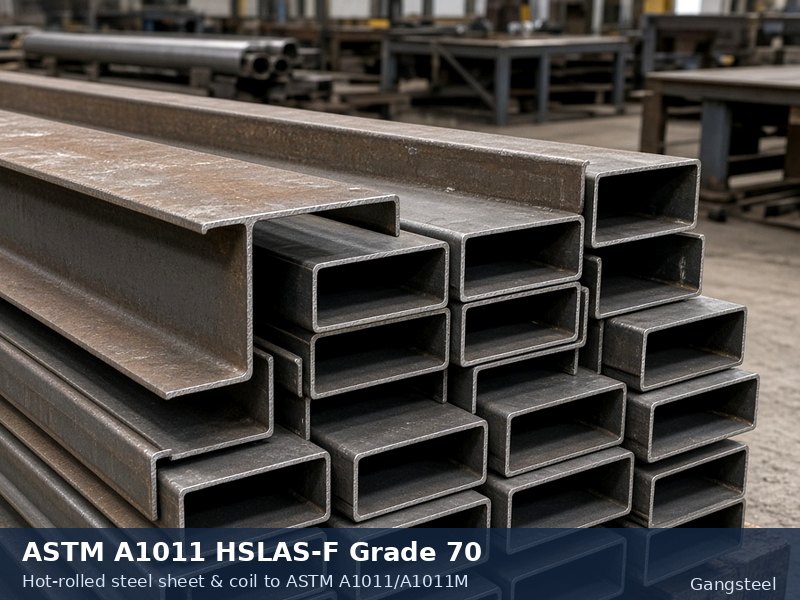
ASTM A1011 HSLAS-F Grade 70 — also written ASTM A1011 HSLAS-F Grade 70, A1011M HSLAS-F Grade 70 [480], A1011 HSLAS-F 70 high-strength low-alloy steel with improved formability, SA-1011 HSLAS-F 70 — is a high-strength low-alloy steel with improved formability in ASTM A1011/A1011M, with a minimum yield strength of 70 ksi [480 MPa] and a minimum tensile strength of 80 ksi [550 MPa]. Gangsteel supplies HSLAS-F Grade 70 as hot-rolled black or pickled and oiled coil, slit strip and cut-to-length sheet for parts that combine high strength with severe forming.
What is ASTM A1011 HSLAS-F Grade 70?
HSLAS-F (the F stands for improved formability) is made with low sulfur and with inclusion shape control, so that the steel bends, flanges and stretches better than ordinary HSLAS of the same strength, especially across the rolling direction. Compared with HSLAS, phosphorus is limited to 0.020% and sulfur to 0.025%, carbon is held to 0.15% maximum and the elongation requirement is higher. There is no class subdivision.
ASTM A1011 HSLAS-F Grade 70 Chemical Composition (Heat Analysis, %)
| Designation | C | Mn | P | S | Cu | Ni | Cr | Mo | V | Cb (Nb) | Ti | N |
|---|---|---|---|---|---|---|---|---|---|---|---|---|
| HSLAS-F Grade 70 | 0.15 | 1.65 | 0.020 | 0.025 | 0.20 | 0.20 | 0.15 | 0.16 | 0.005 min | 0.005 min | 0.005 min | report |
Columbium (niobium), vanadium, titanium or molybdenum are added singly or in combination; the 0.005% minimum applies only to the elements selected. The purchaser may restrict nitrogen. Aluminium and silicon are reported. Product (check) analysis tolerances follow ASTM A568/A568M.
ASTM A1011 HSLAS-F Grade 70 Mechanical Properties
| Property | Requirement |
|---|---|
| Yield strength | 70 ksi [480 MPa] min |
| Tensile strength | 80 ksi [550 MPa] min |
| Elongation in 2 in [50 mm], over 0.097 in [2.5 mm] | ≥20% |
| Elongation in 2 in [50 mm], 0.097 in [2.5 mm] and under | ≥18% |
| Suggested min. inside radius, 90° cold bend | 2t |
Testing follows the same rules as the other high-strength designations of A1011: longitudinal full-thickness specimens, two tests per heat or 50 tons, 0.2% offset or 0.5% extension-under-load yield. The bend radius is the non-mandatory guide of Appendix X1.
Delivery Condition and Heat Treatment
ASTM A1011 HSLAS-F Grade 70 is delivered in the hot-rolled condition. A1011 does not call for normalizing, quenching or any other post-rolling heat treatment: the strength and ductility are set on the hot strip mill by the chemistry, the finishing temperature, run-out-table cooling and the coiling temperature. The default surface is as rolled with its mill scale, and the purchaser may order the coil pickled (and oiled) or blast cleaned instead. Edges are supplied as mill edge unless cut edge is ordered, and general requirements such as dimensional tolerances, flatness and coil packaging follow ASTM A568/A568M for sheet or ASTM A749/A749M for strip.
| Item | Delivery condition per ASTM A1011/A1011M |
|---|---|
| Condition | Hot rolled (as rolled), coils or cut lengths |
| Surface finish | As rolled with mill scale (default); pickled, or blast cleaned when ordered |
| Oiling | As-rolled material is shipped dry; pickled or blast-cleaned material is oiled unless ordered dry |
| Edges | Mill edge or cut (slit / trimmed) edge |
| Product forms | Sheet (coils, cut-to-length sheets) and strip (narrow coils, slit strip) |
| General requirements | ASTM A568/A568M for sheet; ASTM A749/A749M for strip |
| Heat treatment | None required by A1011; properties come from hot rolling and controlled coiling |
Ordering Information
| Ordering item | What to state on the enquiry |
|---|---|
| Standard | ASTM A1011 or A1011M with year of issue (we work to the current edition unless a year is stated) |
| Designation | HSLAS-F Grade 70, e.g. “ASTM A1011M-23, HSLAS-F Grade 480, pickled and oiled, 3.5 x 1219 mm coil” |
| Copper bearing | State when copper-bearing steel is required (Cu 0.20% min) |
| Finish | As rolled, pickled, or blast cleaned |
| Oiling | Oiled or dry (pickled / blasted material is normally oiled) |
| Edge | Mill edge or cut edge |
| Dimensions | Thickness, width, and length for cut lengths; coil ID, maximum OD and maximum coil mass for coils |
| Application | Part name or end use, so forming and surface requirements can be checked |
| Reports | Heat analysis and mechanical test report requirements, third-party inspection if any |
Comparable Grades
By minimum yield strength and their low-sulfur, cold-forming design, the closest EN 10149-2 thermomechanically rolled strip grade is S500MC (approximate comparison; thickness bands and test rules differ).
Applications
HSLAS-F Grade 70 is chosen for automotive chassis and suspension parts, wheels, cross members, seat structures, crane and trailer parts and roll-formed sections that need tight bends or flanging at high strength.
Documents, Inspection and Lead Time
Every ASTM A1011 HSLAS-F Grade 70 shipment from Gangsteel is supplied with a mill test certificate to EN 10204 type 3.1 that states the ASTM designation and year, the designation, grade, type or class, the heat number, the heat analysis and, for structural and high-strength designations, the tension test results, together with the purchase order number. Third-party inspection to EN 10204 type 3.2 by SGS, BV, TUV, LR or another agency nominated by the buyer can be arranged before shipment. Each coil or lift carries a tag with the specification, designation, heat number, size and mass.
Lead time is confirmed with each enquiry against the current hot strip mill rolling schedule, the thickness and width mix and any pickling, slitting or cut-to-length processing required, so please send the size list and quantity per item for a firm delivery date.
FAQ
How is HSLAS-F Grade 70 different from HSLAS Grade 70?
Both have the same minimum yield of 70 ksi [480 MPa]. HSLAS-F adds low sulfur (0.025% max) and inclusion control, limits phosphorus to 0.020% and carbon to 0.15%, and requires higher elongation: 20% over 0.097 in, against 14% for HSLAS Grade 70. The suggested 90° bend radius is 2t, against 3½t for HSLAS Grade 70 Class 1.
What does inclusion control mean in practice?
Elongated manganese sulfide inclusions make hot-rolled strip crack when it is bent across the rolling direction. HSLAS-F steels keep sulfur low and treat the melt (typically with calcium) so that the remaining inclusions are small and rounded. The result is more uniform bendability in the longitudinal and transverse directions.
Which bend radius should I design for?
Appendix X1 suggests a minimum inside radius of 2t for 90° bends in HSLAS-F Grade 70. That is a guide, not a guarantee; the actual limit depends on edge condition, bend direction and tooling, so a trial on the first coil is advised.
Is HSLAS-F Grade 70 weldable?
Yes. Carbon is 0.15% maximum and manganese 1.65% maximum, and the strength comes from microalloying, so the steel welds well with MIG/MAG, laser and resistance processes. Heat input should be controlled to avoid softening of the heat-affected zone, which is characteristic of all thermomechanically rolled microalloyed strip.
What documents come with the coils?
Each shipment has an EN 10204 3.1 certificate showing the heat analysis and tension test results, the ASTM designation and year, the grade, heat number and order number; third-party 3.2 inspection can be arranged.
Related ASTM A1011 Designations
HSLAS-F Grade 50 | HSLAS-F Grade 60 | HSLAS-F Grade 80 | ASTM A1011/A1011M standard overview