


GB-T1591 Steel Plate
GB/T 1591 Q355ND Normalized Steel Plate, Q355N D Grade
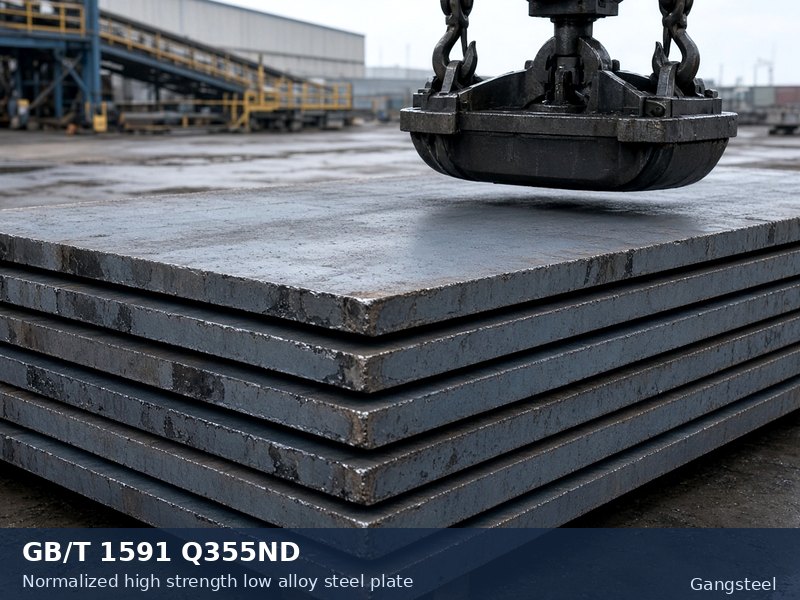
Q355ND — also written GB/T 1591 Q355ND, GB/T 1591-2018 Q355ND, Q355ND steel plate, Q355 N D, Q355ND (normalized) low alloy high strength steel — is a high-strength low-alloy structural steel of the Chinese standard GB/T 1591-2018, delivered in the normalized or normalized rolled condition with a minimum upper yield strength of 355 MPa for thickness up to 16 mm and quality grade D impact toughness. Gangsteel supplies Q355ND steel plate, wide plate and, on request, sections and strip for welded structures in China and export projects.
What is Q355ND?
The designation is built from Q (yield), the minimum upper yield strength 355 MPa, the delivery code N and the quality grade D. GB/T 1591-2018 introduced the delivery code: hot-rolled grades carry no code (for example Q355B), normalized and normalized-rolled grades carry N, and thermomechanically rolled grades carry M. The quality grade sets the impact test temperature: B at 20 °C, C at 0 °C, D at −20 °C, E at −40 °C and F at −60 °C. In the normalized condition the steel is heated above Ac3 and air cooled (or the final rolling passes are made in the normalizing temperature range), giving a uniform fine-grained ferrite-pearlite structure whose properties survive a later normalizing or hot forming by the user. Under the 2008 edition this steel was ordered as Q345D with the delivery condition stated separately.
Q355ND Chemical Composition (Heat Analysis, %)
| Grade | C | Si | Mn | P | S | Nb | V | Ti | Cr | Ni | Cu | Mo | N | Als |
|---|---|---|---|---|---|---|---|---|---|---|---|---|---|---|
| Q355ND | 0.20 | 0.50 | 0.90–1.65 | 0.030 | 0.025 | 0.005–0.05 | 0.01–0.12 | 0.006–0.05 | 0.30 | 0.50 | 0.40 | 0.10 | 0.015 | ≥0.015 |
- At least one of the grain-refining elements Al, Nb, V and Ti must be present at or above its listed minimum; when Nb, V or Ti is added to the minimum level, the aluminium minimum does not apply. Total aluminium Alt ≥0.020% may replace acid-soluble aluminium Als ≥0.015%.
- The titanium maximum may be raised to 0.20%.
- For sections and bars, phosphorus and sulfur limits may each be 0.005% higher.
- Product (check) analysis tolerances follow GB/T 222; the steel is made in a converter or electric furnace and may be secondary refined.
Q355ND Carbon Equivalent
| Thickness, mm | ≤63 | >63–100 | >100–250 | >250–400 |
|---|---|---|---|---|
| CEV max, % | 0.43 | 0.45 | 0.45 | by agreement |
CEV = C + Mn/6 + (Cr + Mo + V)/5 + (Ni + Cu)/15, calculated from the heat analysis and reported on the mill certificate.
Q355ND Mechanical Properties
| Thickness, mm | ≤16 | >16–40 | >40–63 | >63–80 | >80–100 | >100–150 | >150–200 | >200–250 |
|---|---|---|---|---|---|---|---|---|
| ReH min, MPa | 355 | 345 | 335 | 325 | 315 | 295 | 285 | 275 |
| Thickness, mm | ≤100 | >100–200 | >200–250 |
|---|---|---|---|
| Rm, MPa | 470–630 | 450–600 | 450–600 |
| Thickness, mm | ≤16 | >16–40 | >40–63 | >63–80 | >80–200 | >200–250 |
|---|---|---|---|---|---|---|
| A min, % | 22 | 22 | 22 | 21 | 21 | 21 |
Tensile test pieces are transverse for plate and strip of width 600 mm or more and longitudinal for other products. Where through-thickness (Z-direction) properties are required, the reduction of area is tested to GB/T 5313 and the suffix Z15, Z25 or Z35 is added to the grade, for example Q355NDZ25.
Q355ND Impact Test (Charpy V-notch)
| Test temperature | KV2 min, longitudinal | KV2 min, transverse |
|---|---|---|
| 20 °C | 55 J | 31 J |
| 0 °C | 47 J | 27 J |
| −20 °C | 40 J | 20 J |
The impact test applies from 6 mm thickness (12 mm diameter for bars), using 10 × 10 × 55 mm specimens; for thinner material 7.5 mm or 5 mm sub-size specimens are used, with 75% and 50% of the required values. Longitudinal specimens are used unless transverse testing is agreed. Unless the order states the test temperature, Q355ND is tested at −20 °C. By agreement, grade D may be tested at −30 °C with KV2 ≥27 J longitudinal.
Bend Test
| Thickness a, mm | ≤16 | >16–100 |
|---|---|---|
| 180° bend, mandrel diameter D | 2a | 3a |
The bend test is made at the purchaser’s request; it can be omitted when the supplier guarantees the result.
Delivery Condition and Heat Treatment
Q355ND is delivered normalized (N) or normalized rolled; the normalized condition includes normalized plus tempered (N+T). In normalizing, the plate is heated to a temperature above Ac3 and cooled in still air; in normalized rolling, the final deformation is carried out in the same temperature range so that the result is equivalent. Because the properties come from a normalized microstructure, they are restored if the user normalizes the plate again, which makes N steels suitable for hot forming and for stress relieving after welding.
| Item | Requirement / practice |
|---|---|
| Delivery condition | Normalized (N), normalized + tempered, or normalized rolled |
| Hot forming by user | Possible in the normalizing range; properties are restored |
| Post-weld heat treatment | Stress relieving possible; qualify the procedure |
| Thickness range of the table | Up to 250 mm (250–400 mm by agreement) |
| Dimensions | GB/T 709 plate/strip; GB/T 706, GB/T 11263 sections; GB/T 702 bars |
Ordering Information
| Ordering item | What to state on the enquiry |
|---|---|
| Standard | GB/T 1591-2018 |
| Grade | Q355ND (add Z15/Z25/Z35 if through-thickness properties are required) |
| Dimensions | Thickness, width, length; tolerance class to GB/T 709 (e.g. class B) |
| Impact test | Test temperature if different from the default, and longitudinal or transverse |
| Optional tests | Bend test, ultrasonic testing (e.g. GB/T 2970 level), product analysis, CEV/Pcm limit |
| Surface | As rolled, shot blasted and primed if required |
| Inspection | Mill certificate 3.1 or third-party 3.2 |
Comparable Grades
Annex A of GB/T 1591-2018 lists ISO 630-3 S355ND and EN 10025-3 S355N as the comparable grades of Q355ND, and Q345D (normalized) as the corresponding designation in the 2008 edition. The comparison is approximate: thickness bands, impact energies and CEV limits are not identical, so the exact standard must be stated on the order.
Applications
Q355ND is used for pressure-free welded structures that need good toughness after forming: bridges, building frames, cranes, offshore and port equipment, wind tower flanges and transition pieces, mining machinery and storage tanks. Quality grade D is selected where the lowest service temperature or the design code calls for impact toughness at −20 °C.
Documents, Inspection and Lead Time
Q355ND plates from Gangsteel are supplied with a mill test certificate to EN 10204 type 3.1 (GB/T 247 quality certificate) giving heat analysis, CEV, tensile and impact results and the delivery condition. Acceptance is by batch: each batch is of one grade, heat, size and delivery condition and weighs no more than 60 t, with one tensile test, one bend test (if ordered) and three impact specimens per batch. Third-party inspection to EN 10204 3.2 by SGS, BV, TUV, LR, DNV or ABS can be arranged. Lead time is confirmed with each enquiry against the mill rolling schedule, the thickness and the normalizing route, so please send the size list and quantity.
FAQ
What does each part of the designation Q355ND mean?
Q stands for yield strength, 355 is the minimum upper yield strength in MPa for thickness up to 16 mm, N is the delivery condition (normalized or normalized rolled) and D is the quality grade, which sets the Charpy impact requirement. The yield requirement decreases with thickness; for example, it is 335 MPa at 40–63 mm.
What is the difference between Q355ND and Q355MD?
Both have the same minimum yield strength and quality grade, but they are made by different routes. The N grade is normalized, has a ferrite-pearlite structure, allows higher carbon (up to 0.20%) and keeps its properties after hot forming or a later normalizing treatment. The M grade is thermomechanically rolled with lower carbon (0.14% max for Q355M), so its CEV is lower and it welds with less preheat, but it must not be normalized or hot formed. Choose N for hot-formed parts and thick normalized sections, and M for highly welded, weight-optimised structures.
At what temperature is Q355ND impact tested?
Unless the order states otherwise, Q355ND is tested at −20 °C, and the minimum average energy there is 40 J longitudinal (20 J transverse) on 10 mm specimens. The standard also lists the values at higher test temperatures, which apply if the purchaser orders a different test temperature.
Is Q355ND weldable?
Yes. GB/T 1591 controls weldability through the carbon equivalent: for Q355ND the CEV maximum is 0.43 for the thinnest band (up to 63 mm). With these limits the steel can be welded by SMAW, GMAW, FCAW and SAW using matching low-hydrogen consumables; preheat depends on thickness, CEV, joint restraint and hydrogen level and should be set by the welding procedure qualification.
Which thickness can be supplied in Q355ND?
The property tables of GB/T 1591-2018 for Q355N cover thicknesses up to 250 mm (up to 400 mm by agreement for the CEV limits). Plate dimensions and tolerances follow GB/T 709. Send us the thickness, width and length you need and we will confirm the mill and delivery route.
Related GB/T 1591 Grades
Q355NB | Q355NC | Q355NE | Q355NF | Q355MD | Q355D (hot rolled) | Q345D (2008 designation) | GB/T 1591-2018 standard overview
-

GB-T1591 Q460D Steel plate supp
Gangsteel sell GB-T1591 Q460D Low alloy and high strength steel plate, heavy plate and wide, heavy plate.
-

GB-T1591 Q345E Steel Plate supp
Gangsteel sell GB-T1591 Q345E Low alloy and high strength steel plate, heavy plate and wide, heavy plate,
-

GB-T1591 Q345D Carbon steel pla
Gangsteel sell GB-T1591 Q345D Low alloy and high strength steel plate, heavy plate and wide, heavy plate, Which
-

GB-T1591 Q345B Carbon steel pla
Gangsteel sell GB-T1591 Q345B Low alloy and high strength steel plate, heavy plate and wide, heavy plate,