


GB-T1591 Steel Plate
GB/T 1591 Q620MD TMCP Steel Plate, Q620M D Grade
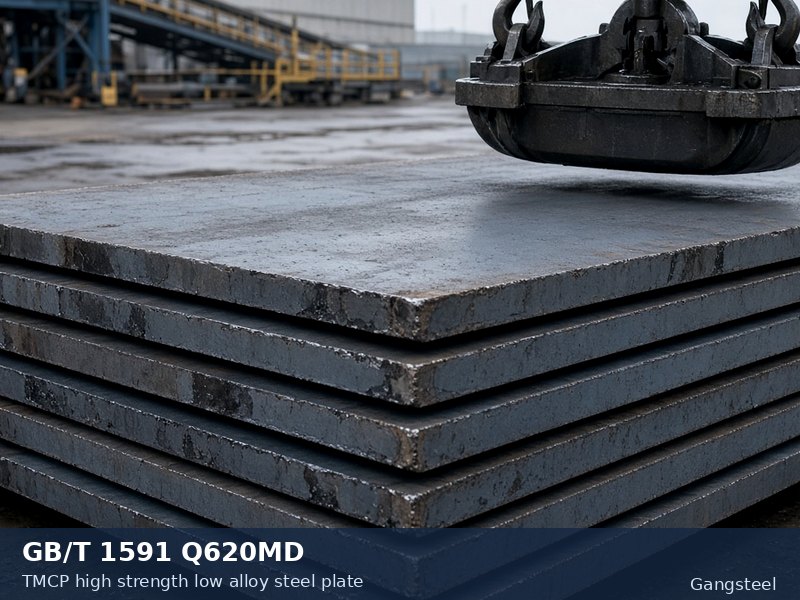
Q620MD — also written GB/T 1591 Q620MD, GB/T 1591-2018 Q620MD, Q620MD steel plate, Q620 M D, Q620MD (TMCP) low alloy high strength steel — is a high-strength low-alloy structural steel of the Chinese standard GB/T 1591-2018, delivered in the thermomechanically rolled (TMCP) condition with a minimum upper yield strength of 620 MPa for thickness up to 16 mm and quality grade D impact toughness. Gangsteel supplies Q620MD steel plate, wide plate and, on request, sections and strip for welded structures in China and export projects.
What is Q620MD?
The designation is built from Q (yield), the minimum upper yield strength 620 MPa, the delivery code M and the quality grade D. GB/T 1591-2018 introduced the delivery code: hot-rolled grades carry no code (for example Q355B), normalized and normalized-rolled grades carry N, and thermomechanically rolled grades carry M. The quality grade sets the impact test temperature: B at 20 °C, C at 0 °C, D at −20 °C, E at −40 °C and F at −60 °C. TMCP steel is rolled with controlled temperature and reduction in the final passes, often followed by accelerated cooling, so the strength comes from a very fine grain at low carbon. This gives lower carbon equivalent and better weldability than a normalized steel of the same strength, but the properties are not retained after normalizing or hot forming. Under the 2008 edition this steel was ordered as Q620D with the delivery condition stated separately.
Q620MD Chemical Composition (Heat Analysis, %)
| Grade | C | Si | Mn | P | S | Nb | V | Ti | Cr | Ni | Cu | Mo | N | B | Als |
|---|---|---|---|---|---|---|---|---|---|---|---|---|---|---|---|
| Q620MD | 0.18 | 0.60 | 2.60 | 0.030 | 0.025 | 0.01–0.11 | 0.01–0.12 | 0.006–0.05 | 1.00 | 0.80 | 0.80 | 0.30 | 0.025 | 0.004 | ≥0.015 |
- At least one of the grain-refining elements Al, Nb, V and Ti must be present at or above its listed minimum; when Nb, V or Ti is added to the minimum level, the aluminium minimum does not apply. Total aluminium Alt ≥0.020% may replace acid-soluble aluminium Als ≥0.015%.
- The titanium maximum may be raised to 0.20%.
- For sections and bars, phosphorus and sulfur limits may each be 0.005% higher.
- Product (check) analysis tolerances follow GB/T 222; the steel is made in a converter or electric furnace and may be secondary refined.
Q620MD Carbon Equivalent
| Thickness, mm | ≤16 | >16–40 | >40–63 | >63–120 | >120–150 (bars only) | Pcm max, % |
|---|---|---|---|---|---|---|
| CEV max, % | 0.48 | 0.48 | 0.48 | 0.49 | 0.49 | 0.25 |
When the carbon content of a TMCP steel is 0.12% or less, the weld cracking parameter Pcm is used instead of CEV; Pcm = C + Si/30 + Mn/20 + Cu/20 + Ni/60 + Cr/20 + Mo/15 + V/10 + 5B.
CEV = C + Mn/6 + (Cr + Mo + V)/5 + (Ni + Cu)/15, calculated from the heat analysis and reported on the mill certificate.
Q620MD Mechanical Properties
| Thickness, mm | ≤16 | >16–40 | >40–63 | >63–80 |
|---|---|---|---|---|
| ReH min, MPa | 620 | 610 | 600 | 580 |
| Thickness, mm | ≤40 | >40–63 | >63–80 |
|---|---|---|---|
| Rm, MPa | 710–880 | 690–880 | 670–860 |
Minimum elongation after fracture A: 15% (GB/T 1591-2018 Table 10).
Tensile test pieces are transverse for plate and strip of width 600 mm or more and longitudinal for other products. Where through-thickness (Z-direction) properties are required, the reduction of area is tested to GB/T 5313 and the suffix Z15, Z25 or Z35 is added to the grade, for example Q620MDZ25.
Q620MD Impact Test (Charpy V-notch)
| Test temperature | KV2 min, longitudinal | KV2 min, transverse |
|---|---|---|
| −20 °C | 47 J | 27 J |
The impact test applies from 6 mm thickness (12 mm diameter for bars), using 10 × 10 × 55 mm specimens; for thinner material 7.5 mm or 5 mm sub-size specimens are used, with 75% and 50% of the required values. Longitudinal specimens are used unless transverse testing is agreed. Unless the order states the test temperature, Q620MD is tested at −20 °C. By agreement, grade D may be tested at −30 °C with KV2 ≥27 J longitudinal.
Bend Test
| Thickness a, mm | ≤16 | >16–100 |
|---|---|---|
| 180° bend, mandrel diameter D | 2a | 3a |
The bend test is made at the purchaser’s request; it can be omitted when the supplier guarantees the result.
Delivery Condition and Heat Treatment
Q620MD is delivered in the thermomechanically rolled condition (M), which includes TMCP plus tempering. The final rolling passes are made in a temperature range where the austenite does not fully recrystallize, often followed by accelerated cooling. The fine grain produced in this way cannot be reproduced by later heat treatment, so the steel must not be normalized or hot formed by the user; stress relieving after welding is possible but the temperature should be agreed and the procedure qualified.
| Item | Requirement / practice |
|---|---|
| Delivery condition | Thermomechanically rolled (TMCP), or TMCP + tempering |
| Normalizing / hot forming by user | Not permitted; properties would be lost |
| Cold forming | Suitable; bend to Table 12 |
| Post-weld heat treatment | Possible at an agreed temperature; qualify the procedure |
| Thickness range of the table | Up to 80 mm |
| Dimensions | GB/T 709 plate/strip; GB/T 706, GB/T 11263 sections; GB/T 702 bars |
Ordering Information
| Ordering item | What to state on the enquiry |
|---|---|
| Standard | GB/T 1591-2018 |
| Grade | Q620MD (add Z15/Z25/Z35 if through-thickness properties are required) |
| Dimensions | Thickness, width, length; tolerance class to GB/T 709 (e.g. class B) |
| Impact test | Test temperature if different from the default, and longitudinal or transverse |
| Optional tests | Bend test, ultrasonic testing (e.g. GB/T 2970 level), product analysis, CEV/Pcm limit |
| Surface | As rolled, shot blasted and primed if required |
| Inspection | Mill certificate 3.1 or third-party 3.2 |
Comparable Grades
Annex A of GB/T 1591-2018 gives Q620D (TMCP condition) in the 2008 edition as the corresponding grade of Q620MD and lists no direct ISO 630 or EN 10025 equivalent. For projects specified to European standards, the nearest strength levels are compared on a case-by-case basis.
Applications
Q620MD is used for high-strength welded structures where weight saving is critical: crane booms, mobile and tower cranes, construction and mining machinery, truck chassis, hydraulic supports and bridge components. Quality grade D is selected where the lowest service temperature or the design code calls for impact toughness at −20 °C.
Documents, Inspection and Lead Time
Q620MD plates from Gangsteel are supplied with a mill test certificate to EN 10204 type 3.1 (GB/T 247 quality certificate) giving heat analysis, CEV, tensile and impact results and the delivery condition. Acceptance is by batch: each batch is of one grade, heat, size and delivery condition and weighs no more than 60 t, with one tensile test, one bend test (if ordered) and three impact specimens per batch. Third-party inspection to EN 10204 3.2 by SGS, BV, TUV, LR, DNV or ABS can be arranged. Lead time is confirmed with each enquiry against the mill rolling schedule, the thickness and the TMCP route, so please send the size list and quantity.
FAQ
What does each part of the designation Q620MD mean?
Q stands for yield strength, 620 is the minimum upper yield strength in MPa for thickness up to 16 mm, M is the delivery condition (thermomechanically rolled (TMCP)) and D is the quality grade, which sets the Charpy impact requirement. The yield requirement decreases with thickness; for example, it is 600 MPa at 40–63 mm.
Why is Q620MD only available as TMCP?
GB/T 1591-2018 defines strength levels of 500 MPa and above only in the thermomechanically rolled condition. At these strengths a normalized microstructure would need too much carbon and alloy to be weldable; TMCP with accelerated cooling reaches the strength with carbon of 0.18% max and boron-microalloying. For still higher strength or very thick plate, quenched and tempered steels to GB/T 16270 are used.
At what temperature is Q620MD impact tested?
Unless the order states otherwise, Q620MD is tested at −20 °C, and the minimum average energy there is 47 J longitudinal (27 J transverse) on 10 mm specimens. The test is made on three specimens per batch, taken from one end of the product.
Is Q620MD weldable?
Yes. GB/T 1591 controls weldability through the carbon equivalent: for Q620MD the CEV maximum is 0.48 for the thinnest band (up to 16 mm), and Pcm 0.25 maximum applies when carbon is 0.12% or less. With these limits the steel can be welded by SMAW, GMAW, FCAW and SAW using matching low-hydrogen consumables; preheat depends on thickness, CEV, joint restraint and hydrogen level and should be set by the welding procedure qualification.
Which thickness can be supplied in Q620MD?
The property tables of GB/T 1591-2018 for Q620M cover thicknesses up to 80 mm. Plate dimensions and tolerances follow GB/T 709. Send us the thickness, width and length you need and we will confirm the mill and delivery route.
Related GB/T 1591 Grades
Q620MC | Q620ME | Q620D (2008 designation) | GB/T 1591-2018 standard overview
-

GB-T1591 Q460D Steel plate supp
Gangsteel sell GB-T1591 Q460D Low alloy and high strength steel plate, heavy plate and wide, heavy plate.
-

GB-T1591 Q345E Steel Plate supp
Gangsteel sell GB-T1591 Q345E Low alloy and high strength steel plate, heavy plate and wide, heavy plate,
-

GB-T1591 Q345D Carbon steel pla
Gangsteel sell GB-T1591 Q345D Low alloy and high strength steel plate, heavy plate and wide, heavy plate, Which
-

GB-T1591 Q345B Carbon steel pla
Gangsteel sell GB-T1591 Q345B Low alloy and high strength steel plate, heavy plate and wide, heavy plate,