


API 2Y Offshore Steel Plate
API 2Y Grade 60 Quenched and Tempered Offshore Plate
API 2Y Grade 60 — also written API 2Y-60, API Spec 2Y Gr 60, 2Y60 and API 2Y Grade 60 offshore plate — is a quenched-and-tempered steel plate grade for welded offshore structures. Gangsteel reviews 2Y-60 enquiries by thickness, supplementary requirements and Z-direction duty, not only by nominal yield strength.
Edition boundary: API Spec 2Y, fifth edition (December 2006), reaffirmed and still catalogued as the current edition, covers Grade 50 and Grade 60 quenched-and-tempered plate. Grade 42 and Grade 50T appeared in the 1999 fourth edition and are not presented here as current grades. Chemistry elements not corroborated for the fifth edition are omitted rather than filled from older or mill-specific tables.
What Is API 2Y Grade 60?
API 2Y covers high-strength plate for selected critical portions of offshore structures that must resist impact, plastic fatigue loading and lamellar tearing. Grade 60 is covered up to 100 mm (4 in.) inclusive. Typical critical uses are tubular joints, stiffened plate construction and intersections where part of the plate is loaded through its thickness.
| Item | Requirement |
|---|---|
| Grade / marking basis | API 2Y-60 |
| Product form | Quenched-and-tempered steel plate |
| Maximum covered thickness | 100 mm (4 in.) |
| Edition | Fifth edition, December 2006 |
| Typical critical locations | Tubular joints, stiffened plates, Z-loaded intersections |
API 2Y Grade 60 Chemical Composition
| Element | Requirement |
|---|---|
| C | ≤0.12 |
| P | ≤0.030 |
| S | ≤0.010 |
| N | ≤0.012; not intentionally added |
This is deliberately not a complete Table 1 reproduction. Manganese, silicon, aluminium, titanium, niobium, nickel, chromium, molybdenum and copper limits must be taken from the fifth-edition text named in the order. Older fourth-edition carbon and manganese values are not substituted, because that would mix editions. Report intentionally added elements and carbon-equivalent elements on the certificate.
| Formula / limit | Requirement |
|---|---|
| CE | C + Mn/6 + (Cr + Mo + V)/5 + (Ni + Cu)/15 |
| Pcm | C + Si/30 + (Mn + Cu + Cr)/20 + Ni/60 + Mo/15 + V/10 + 5B |
| Grade 60 maxima | Thickness-dependent CE and Pcm maxima as specified in the standard; confirm on order |
API 2Y Grade 60 Mechanical Properties
| Thickness | Yield strength | Tensile strength minimum | Elongation 50 mm minimum | Elongation 200 mm minimum |
|---|---|---|---|---|
| ≤25 mm (1 in.) | 414–621 MPa (60–90 ksi) | 517 MPa (75 ksi) | 22% | 16% |
| >25 mm to 100 mm (4 in.) | 414–586 MPa (60–85 ksi) | 517 MPa (75 ksi) | 22% | 16% |
| Specimen / location | Test temperature | Minimum energy |
|---|---|---|
| Full-size, transverse, mid-width and mid-thickness | −40 °C (−40 °F) | 48 J (35 ft-lbf) average / 41 J (30 ft-lbf) single |
API 2Y also permits defined sub-size or lower-temperature options; the selected option must keep its matching energy and temperature values. Do not combine a sub-size result with full-size acceptance values. Lower-temperature service should use supplementary requirement S2 or project testing rather than relying on the base −40 °C option.
Delivery Condition and Heat Treatment
API 2Y plate is supplied quenched and tempered. Because forming or post-weld heat treatment above the manufacturing tempering temperature risks irreversible loss of strength and toughness, warm forming and higher-temperature PWHT require verification or simulation.
| Parameter | Requirement |
|---|---|
| Austenitizing range | 815–925 °C (1500–1700 °F) |
| Quench | Suitable liquid medium |
| Tempering range | 565–705 °C (1050–1300 °F) |
| Verification threshold | Not required for heating not exceeding 205 °C (400 °F) |
| Above manufacturing tempering temperature | Simulate per supplementary requirement S9 or verify finished properties |
Supplementary requirements commonly reviewed include S1 ultrasonic examination, S2 lower-temperature toughness, S4 through-thickness testing, S5 low-sulfur steel, S7 low nitrogen, S8 strain-aged Charpy and S9 simulated PWHT. S5 does not replace S4, and neither is automatically included unless ordered.
Equivalent and Related Grades
API 2H Grade 60 and API 2W Grade 60 share the same nominal strength level in some contexts but use different processing routes and requirements. EN 10225 grades are also not automatic replacements. The standard identifies broad performance relationships, yet substitution needs engineering acceptance of chemistry, CE, thickness, toughness, Z-direction properties and supplementary requirements.
Applications, Cutting and Welding
Use Grade 60 for critical offshore nodes and stiffened plates where its strength, toughness and lamellar-tearing control are needed. Quenched-and-tempered steel has a characteristically high yield/tensile ratio, so weld-metal matching deserves attention. Qualify preheat, heat input and consumables using actual CE/Pcm, thickness and restraint; avoid post-weld heating beyond the verified tempering limit.
Frequently Asked Questions
What is the maximum thickness for API 2Y Grade 60?
The fifth edition covers Grade 60 up to 100 mm (4 in.) inclusive. Plates beyond that range need a different specification or explicit agreement and should not be described as standard API 2Y Grade 60.
Is API 2Y normalized or TMCP plate?
No. API 2Y is the quenched-and-tempered offshore plate specification. API 2H and API 2W cover different processing routes, so the specifications are not interchangeable by name or strength.
What yield strength is required for Grade 60?
It is 414–621 MPa (60–90 ksi) up to 25 mm and 414–586 MPa (60–85 ksi) above 25 mm within the covered thickness. The minimum tensile strength is 517 MPa (75 ksi).
Why are some chemistry elements not listed here?
Only fifth-edition limits corroborated during this review are shown. Omitted elements are not unrestricted; they must be read from the governing fifth-edition table. Older fourth-edition values are not used as a substitute.
What Charpy test is required?
The base full-size option requires 48 J (35 ft-lbf) average / 41 J (30 ft-lbf) single at −40 °C using transverse mid-width, mid-thickness specimens. Sub-size options have their own energy and temperature combinations.
Can API 2Y plate be stress relieved?
Yes, but heating above the manufacturing tempering temperature needs verification or S9 simulated PWHT. Heating not above 205 °C does not require that verification.
Do I need S4 or S5 for Z-loaded joints?
Assess the duty. S4 tests through-thickness reduction of area; S5 reduces sulfur to improve through-thickness potential. S5 is not a substitute for S4.
What should an API 2Y Grade 60 enquiry include?
State API Spec 2Y fifth edition, Grade 60, thickness, width, length, quantity, required supplementary requirements, Charpy option, inspection document and project/class requirements. Lead time is confirmed by enquiry.
Related: API 2Y specification overview · Low alloy and structural plate
For an enquiry, state the complete material designation and edition, product form, dimensions, quantity, inspection document, testing options, packing and destination. Availability and delivery time are confirmed against the actual enquiry; this page is not an inventory or lead-time guarantee.
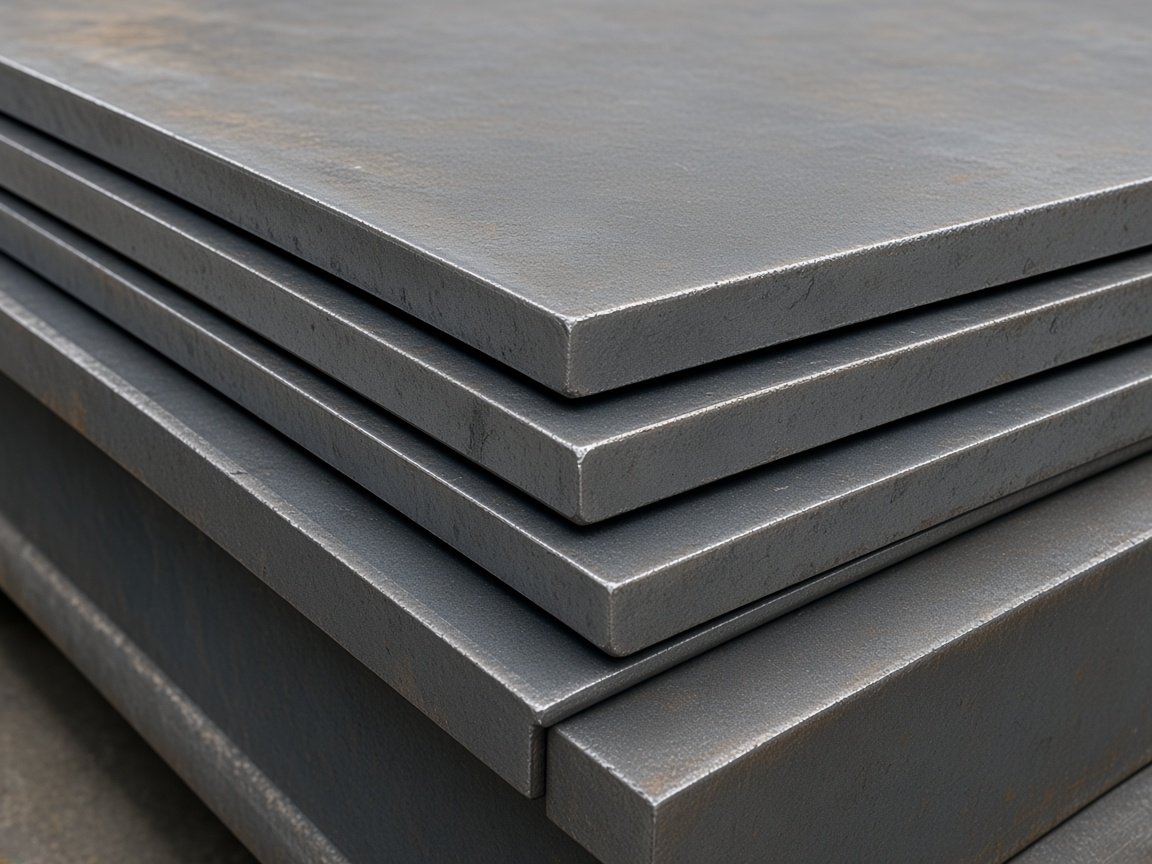
The original generated product-form image is illustrative. Appearance does not identify a steel grade or prove certification.