


API 2Y Offshore Steel Plate
API 2Y Offshore Steel Plate: Grades and Requirements
API 2Y offshore steel plate — also written API Spec 2Y, API 2Y Q&T plate and API 2Y Grade 50/60 — specifies quenched-and-tempered plate for critical portions of welded offshore structures. Gangsteel lists the two grades in the current fifth edition and keeps fourth-edition Grade 42 and Grade 50T out of the current-grade matrix.
Edition boundary: API Spec 2Y, fifth edition (December 2006), reaffirmed and still catalogued as the current edition, covers Grade 50 and Grade 60 quenched-and-tempered plate. Grade 42 and Grade 50T appeared in the 1999 fourth edition and are not presented here as current grades. Chemistry elements not corroborated for the fifth edition are omitted rather than filled from older or mill-specific tables.
All Current API 2Y Grades
| Grade | Maximum thickness | Yield ≤25 mm | Minimum tensile | Grade page |
|---|---|---|---|---|
| Grade 50 | 150 mm | 345–517 MPa | 448 MPa | API 2Y Grade 50 |
| Grade 60 | 100 mm | 414–621 MPa | 517 MPa | API 2Y Grade 60 |
Chemistry and Mechanical Requirements
Verified fifth-edition limits shown on the grade pages include C ≤0.12%, P ≤0.030%, S ≤0.010% and N ≤0.012%. Other Table 1 elements are intentionally omitted rather than borrowed from the 1999 edition. Tensile tests are transverse; the yield range narrows above 25 mm. Base Charpy acceptance is at −40 °C with transverse mid-width, mid-thickness specimens.
| Item | Requirement |
|---|---|
| Delivery | Quenched and tempered |
| Austenitizing | 815–925 °C |
| Tempering | 565–705 °C |
| Fabrication heating above tempering temperature | Verify finished properties or simulate by S9 |
| Common supplements | S1 UT, S2 low-temperature impact, S4 Z-direction, S5 low S, S7 low N, S8 strain-aged CVN, S9 SPWHT |
Applications and Substitution
API 2Y is selected for tubular joints, stiffened plate construction and other intersections where impact, plastic fatigue and lamellar tearing matter. API 2H, API 2W and EN 10225 can be alternatives only after project review because processing route, chemistry and testing differ. Related existing pages: API 2H Grade 50 steel plate, API 2W Grade 50 offshore plate and API 2H and API 2W offshore steel.
Frequently Asked Questions
How many grades are in the current API 2Y edition?
Two: Grade 50 and Grade 60. Grade 42 and Grade 50T belonged to the fourth edition and are not listed as current grades.
What thickness range does API 2Y cover?
Grade 50 up to 150 mm and Grade 60 up to 100 mm, inclusive.
Is API 2Y the same as API 2H?
No. API 2Y is quenched and tempered, while API 2H is a different offshore plate specification with a different route and requirements.
Why does the page not list every chemistry element?
Only limits verified for the fifth edition are published. The remaining elements must be taken from the governing standard text, not from the older edition.
Can API 2Y be hot formed?
Forming or PWHT above the manufacturing tempering temperature risks property loss and must be verified or simulated.
What Charpy temperature is the base requirement?
The base requirement is −40 °C, with grade-specific energy and permitted sub-size options.
When should Z-direction testing be ordered?
Where plate is loaded through thickness, such as many offshore nodes, consider S4 through-thickness testing. S5 low sulfur is complementary, not a substitute.
What is needed for an API 2Y quotation?
Edition, grade, dimensions, quantity, supplementary requirements, Charpy option, inspection document and project/class requirements. Lead time is confirmed by enquiry.
For an enquiry, state the complete material designation and edition, product form, dimensions, quantity, inspection document, testing options, packing and destination. Availability and delivery time are confirmed against the actual enquiry; this page is not an inventory or lead-time guarantee.
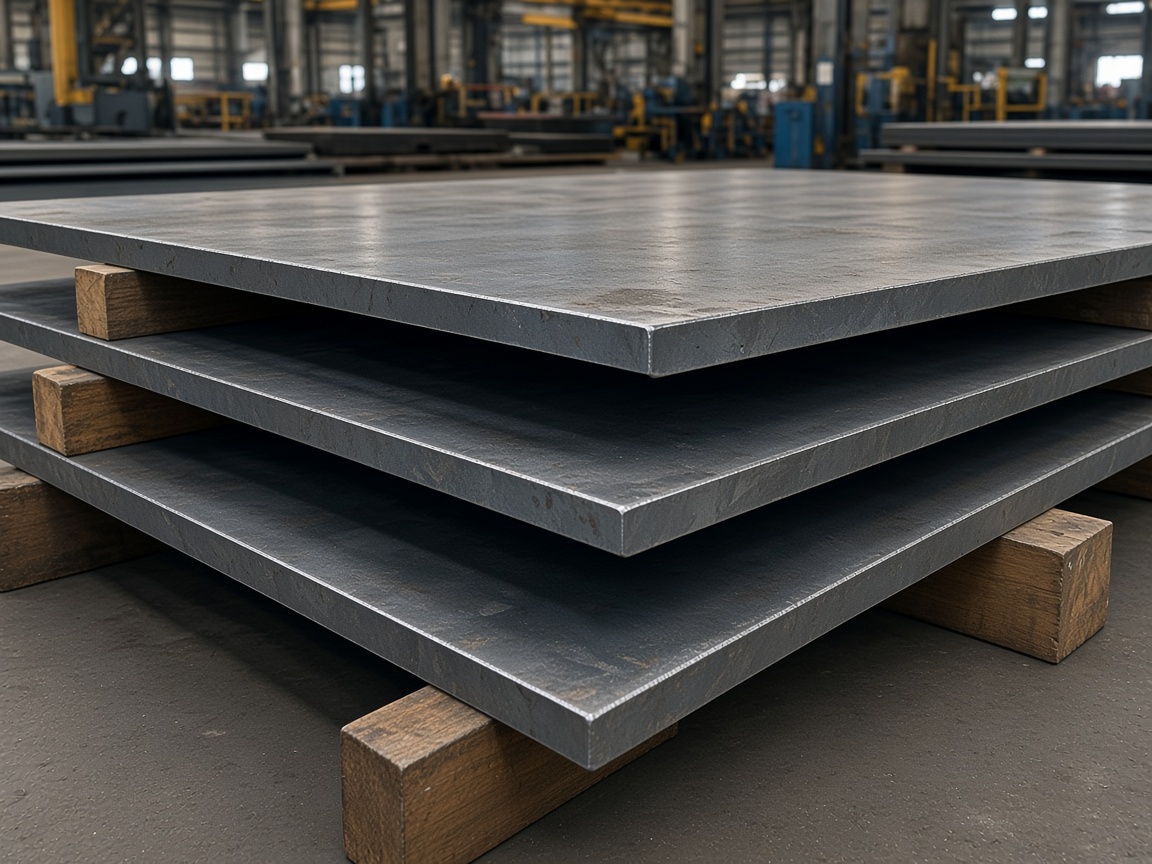
The original generated product-form image is illustrative. Appearance does not identify a steel grade or prove certification.