


Clad Steel Plate
A516 Grade 70 + Titanium Gr 1/2 Clad Steel Plate
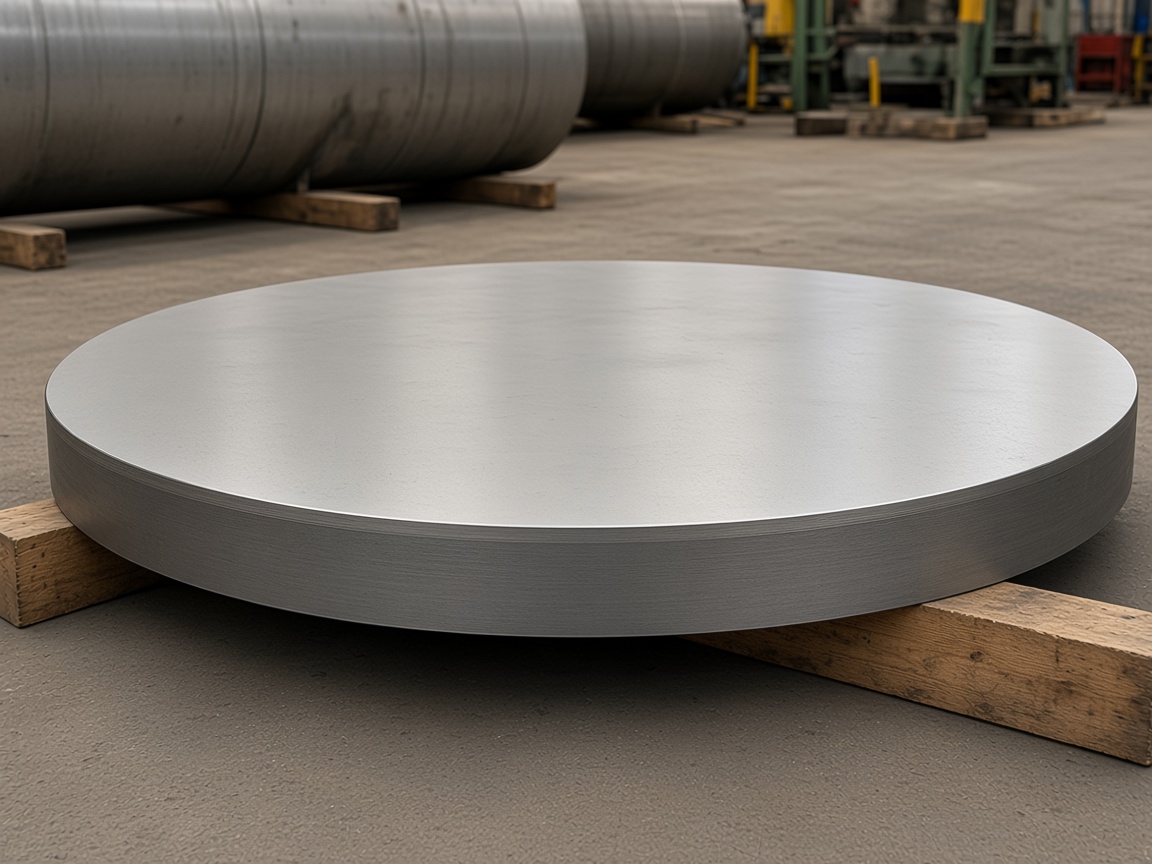
A516 Grade 70 + titanium clad steel plate bonds commercially pure titanium (B265 Grade 1 or Grade 2) to a carbon steel pressure backing. Gangsteel supplies it to ASTM B898 for chloride, seawater and oxidizing-acid equipment where solid titanium would be uneconomic.
Material Pair and Engineering Use
Titanium resists seawater, wet chlorine, chlorides and many oxidizing acids. Clad plate puts a few millimetres of titanium on the wetted side and uses A516 steel for strength. Typical uses are PTA reactors, chlor-alkali equipment, condenser and heat-exchanger tube sheets, and pressure-leach autoclaves.
| Part | Designation | Role |
|---|---|---|
| Backing | ASTM A516/A516M-25 Grade 70 (Grade 60 by order) | Carries pressure and structural load |
| Cladding | ASTM B265 Grade 1 (UNS R50250) or Grade 2 (UNS R50400) | Titanium corrosion face |
| Clad product | ASTM B898-20 (reapproved 2026) | Bond, tests and tolerances |
Backing Steel Chemical Composition
| Backing thickness | C max | Mn | Si | P max | S max |
|---|---|---|---|---|---|
| ≤12.5 mm | 0.27 | 0.85–1.20 | 0.15–0.40 | 0.025 | 0.025 |
| >12.5–50 mm | 0.28 | 0.85–1.20 | 0.15–0.40 | 0.025 | 0.025 |
| >50–100 mm | 0.30 | 0.85–1.20 | 0.15–0.40 | 0.025 | 0.025 |
| >100 mm | 0.31 | 0.85–1.20 | 0.15–0.40 | 0.025 | 0.025 |
The thickness column refers to the steel backing alone. A516/A516M-25 allows 0.06 percentage point more manganese for each 0.01 point of carbon below the maximum, capped at 1.50% (heat) and 1.60% (product). Where Grade 60 backing is ordered instead, its lower carbon maxima and its own 415–550 MPa tensile range apply; the two grades must not be mixed on one certificate.
Cladding Grades
| Grade | Description |
|---|---|
| Grade 1, UNS R50250 | Unalloyed titanium; lowest strength, best formability |
| Grade 2, UNS R50400 | Unalloyed titanium; most widely used clad facing |
| Grades 7 / 11 | Unalloyed titanium plus 0.12–0.25% palladium; for reducing acids and crevice corrosion |
| Chemistry | Interstitial (O, N, C, H) and Fe limits per the ordered B265 edition and grade |
The interstitial element limits are taken from the ordered B265 edition and grade and reported on the titanium certificate. They are not reproduced here because only the B265 mechanical table was read for this page.
Mechanical Properties of the Layers and the Bond
| Layer / reference | Condition | Yield / Rp0.2 min, MPa | Tensile, MPa | Elongation min |
|---|---|---|---|---|
| A516/A516M-25 Grade 70 [485] backing | Plate as ordered; normalized above 1.5 in. [40 mm] | 260 | 485–620 | 21% in 50 mm; 17% in 200 mm |
| Titanium Grade 1, B265-20a | Annealed plate | 138–310 | 240 min | 24% |
| Titanium Grade 2, B265-20a | Annealed plate | 275–450 | 345 min | 20% |
B898 does not require the bonded titanium to keep the mechanical properties of B265 unless that is agreed. The titanium values above describe the cladding stock; the clad plate tensile result comes from the steel alone, and bond shear is a separate interface value.
| Item | Requirement | Order meaning |
|---|---|---|
| Tension test | Base metal only, to A516; cladding removed from specimens cut from the clad plate | Titanium does not enter the certified tensile result |
| Bond shear | Every plate; minimum 20 000 psi (137.9 MPa); specimen from a plate end at the location typical of maximum distance from the explosion initiation point | Interface property, reported for each plate |
| Retest | Only for a defective specimen or method; two adjacent specimens, both must pass | No repeated retesting until a pass |
| Test condition | As shipped, unless simulated post-cladding heat treatment (S5) is ordered | Order S5 if the vessel will be stress relieved |
| Bond integrity | Pulse-echo straight-beam ultrasonic inspection after all processing | State the quality level on the order |
Inch-pound values govern in B898; metric values are conversions. The clauses were read from B898-20, which is listed as reapproved in 2026.
Fabrication Points for This Pair
Titanium cannot be fusion-welded to steel because the melt forms brittle titanium-iron intermetallics. Seams are made by welding the steel, inserting a titanium filler strip and welding a titanium batten strip over the joint to the titanium only, with leak-test holes.
Titanium welds need full inert-gas shielding including trailing and back shielding. Keep iron contamination off the titanium face and use dedicated tools.
Bonding Process, Delivery and Heat Treatment
B898 requires heat treatments performed as needed so both metals meet their specifications and the bond resists disbonding. Titanium and steel react at high temperature, so post-weld heat treatment of titanium-clad equipment is limited in temperature and time. Agree the cycle with the clad manufacturer before ordering and test coupons after the simulated cycle (Supplementary Requirement S5).
| Parameter | Order definition | Engineering note |
|---|---|---|
| Bonding route | Explosion bonding | Titanium on steel cannot be roll bonded in the usual way and is produced by explosion bonding |
| Layer thickness | Backing gage plus minimum facing gage in mm; single- or double-sided | Allow facing margin for grinding, forming and weld restoration; total gage alone does not define the plate. |
| Final thermal condition | As-clad condition; simulated PWHT under S5 if the vessel will be heat treated | Temperature and time limited to protect the bond |
| Surface and edges | Clean titanium face, protected from iron; edges cut as specified | Thermal or mechanical cutting allowed if it does not harm the product |
| Lead time | Confirmed against the enquiry | Depends on plate area, layer gages, quantity, thermal condition and witnessed inspection. |
Inspection and Certification
The titanium clad inspection plan records the per-plate shear test, the ultrasonic quality level and the base and titanium certificates.
| Check | What to specify | Why it matters |
|---|---|---|
| Layer identity | Separate backing and facing certificates with heat numbers | No blended composite analysis |
| Per-plate shear | Result for each plate on the report, including retests | B898-20 requirement |
| Ultrasonic level | Quality level and coverage named on the order | Area integrity |
| Flatness | Standard Table 4 or special flatness for tube sheets | Machining allowance |
| Base tension | Base metal only, cladding removed | Strength basis |
Frequently Asked Questions
Which titanium grade is normally used on A516 clad plate?
Grade 2 is the most common. Grade 1 is chosen when formability matters most, and palladium-bearing Grades 7 or 11 for reducing acids or crevice corrosion.
Why is titanium clad plate always explosion bonded?
Titanium and steel form brittle intermetallics when melted or held hot together. Explosion bonding joins them in the solid state, which is why it is the standard production route.
How are titanium-clad seams welded?
The steel is welded first, then a titanium filler strip is fitted and a titanium batten strip is welded over the joint to the titanium only.
What bond strength does B898 require?
A minimum shear strength of 20 000 psi (137.9 MPa), tested on every plate.
Can titanium clad plate be stress relieved?
Yes, within limited temperature and time. Agree the cycle in advance and order simulated heat-treatment testing under S5.
Is the titanium included in the tensile test?
No. B898 tests the base metal only, with the cladding removed.
Is A516 the only backing used for titanium clad?
No. A516 Grade 60 or 70 is common for plate; forgings such as SA-266 or SA-350 are used for some tube sheets.
What should a titanium clad enquiry include?
B898 edition, B265 grade, backing grade and thickness, minimum titanium thickness, size or diameter, quantity, ultrasonic level, flatness, PWHT and inspection requirements. Lead time is confirmed against the enquiry.
Related Materials
ASTM B898 titanium clad plate; A516 Grade 70 + 90/10 CuNi clad plate; all clad steel plate combinations.