


Abrasion Resistant Steel Plate
Mn13 and X120Mn12 Wear Steel Plate: Scope and Properties
Mn13 wear steel plate — searched as Mn13 plate, high-manganese plate, Hadfield-type steel and X120Mn12 / 1.3401 — requires a more careful order definition than a hardness number. Gangsteel distinguishes the commercial Mn13 description from a named X120Mn12 material specification: the labels are related in market usage but are not an automatic cross-standard equivalence.
Material Identity and Wear Mechanism
The intended material family is austenitic high-manganese steel supplied after solution treatment. Under sufficiently severe impact and compressive deformation, the working surface hardens while the interior retains its toughness. It is not the same metallurgical concept as a through-hardened quenched-and-tempered abrasion plate. Gentle sliding abrasion may not provide enough deformation to activate the expected surface response.
| Name | Meaning |
|---|---|
| Mn13 | Commercial description; order the agreed composition and acceptance requirements |
| X120Mn12 / 1.3401 | A specific named material designation; verify the selected producer specification |
| Hadfield-type steel | Family description, not an all-purpose product certificate |
| Product form here | Rolled plate or cut plate blanks, not a guarantee for cast crusher jaws |
Chemical Composition: Named Material Example
| Element | Published range / maximum |
|---|---|
| C | 1.10–1.30 |
| Si | 0.30–0.50 |
| Mn | 12.00–13.00 |
| P | ≤0.100 |
| S | ≤0.040 |
| Cr | ≤1.50 |
The table identifies a documented X120Mn12 analysis range, not the measured chemistry of a shipment and not a claimed limit from an unspecified national Mn13 plate standard. Require the selected specification and heat analysis on the certificate. Different manganese-steel producers may use different agreed limits; the trade name alone is insufficient for acceptance.
Mechanical Behaviour and Hardness
| Characteristic | Published example | Interpretation |
|---|---|---|
| Typical tensile strength | 800–1100 MPa | Indicative material data; agree acceptance for the actual product |
| Typical delivery hardness | Up to 200 HBW | Solution-treated example, not a hard-face service value |
| Strength after local work hardening | Depends on strain history | No single universal in-service hardness is guaranteed here |
These material-data examples do not define a guaranteed thickness range, yield strength or elongation for an arbitrary Mn13 plate order. Obtain those acceptance requirements for the selected rolled product. A Brinell value measured on a work-hardened cut edge is not the same as delivery hardness measured on an unaffected plate surface.
Delivery Condition and Heat Treatment
Solution treatment aims to dissolve harmful carbide networks and retain an austenitic matrix after rapid cooling. An ordinary stress-relief cycle or the tempering treatment used for low-alloy wear plate is not interchangeable with this route. The producer must establish the solution-treatment and cooling procedure for the actual composition and plate thickness.
| Parameter | Control |
|---|---|
| Delivery condition | Solution-treated austenitic plate, agreed with the producer |
| Temperature and holding time | Established for the ordered composition and section; no universal setpoint asserted |
| Cooling | Rapid cooling under the qualified material procedure |
| Hardness acceptance | State method, location and as-delivered versus work-hardened condition |
| Thickness scope | Specified in the actual plate order and certificate, not inferred from generic material data |
Heating during cutting, welding or straightening can affect local carbide precipitation, distortion and toughness. Maintain traceability through cut blanks and avoid accepting a generic “heat treated” certificate without the actual material condition. The treatment is not described here as quenching and tempering to a fixed through-hardness.
Applications, Cutting and Welding
Potential rolled-plate applications include impact-loaded liners, shot-blast protection, chutes and components exposed to repeated local deformation. Select the material by the real wear mode, impact energy, geometry and replacement strategy. It is not a universal upgrade for low-impact abrasive sliding, and a trade name is not a ballistic approval.
The material work-hardens readily during machining. Plan rigid setups, suitable tooling and an approach that avoids rubbing on a hardened surface. Thermal cutting and welding need a procedure appropriate to austenitic manganese steel, with heat accumulation controlled rather than copied from a carbon-steel preheat chart. Select consumables for the actual joint, including dissimilar-metal joints, and do not assume a generic structural-steel filler is suitable.
Equivalent Grades: What Can Be Compared?
Mn13, X120Mn12 and other high-manganese designations are comparison terms, not unconditional certificates of equivalence. Rolled plate and cast products also have different specifications. Likewise, a nominal 400 or 500 HB through-hardened wear plate is not equivalent to a solution-treated manganese plate simply because the latter may develop a hard working surface.
Frequently Asked Questions
Is Mn13 exactly the same as X120Mn12?
Not automatically. Mn13 is widely used as a commercial family description. X120Mn12 / 1.3401 is a named material designation. The actual standard or producer specification, chemistry, product form and delivery tests must be identified before treating an offered plate as equivalent.
Why can a wear plate arrive with relatively low hardness?
A solution-treated austenitic manganese plate is designed to work harden under suitable impact and compressive deformation. Delivery hardness and developed surface hardness describe different states. Low initial hardness is not, by itself, evidence that a correctly specified manganese plate is unsuitable.
Will the surface always reach a particular hardness in service?
No. The response depends on the applied strain, impact intensity, geometry and wear environment. A guaranteed in-service hardness cannot be inferred from the grade name. Select the steel against the real wear mechanism and validate it in the application.
Which chemistry does the table represent?
It is a documented producer material-data example for X120Mn12 / 1.3401. It is not a universal Mn13 standard requirement and not an analysis of a delivered heat. The purchase order and material certificate must provide the agreed composition and acceptance basis.
Can a casting certificate be used for rolled plate?
Not without an explicit technical and contractual basis. Cast crusher parts and rolled plate are different product forms, with different processing and potentially different acceptance rules. Match the certificate to the material form actually supplied.
Can this material be welded like ordinary carbon steel?
Do not assume so. Austenitic manganese steel needs a welding procedure that controls heat accumulation and selects compatible consumables. Dissimilar joints and repair build-up require their own assessment; a carbon-steel preheat recommendation is not automatically transferable.
Is a through-hardened wear steel an equivalent substitute?
No. Through-hardened low-alloy abrasion plate and work-hardening manganese steel use different wear-resistance mechanisms. Compare impact, abrasion mode, forming, welding and the required delivery condition rather than replacing one by hardness number alone.
What should a Mn13 plate enquiry include?
State rolled plate or cut blanks, the exact material specification, dimensions, composition limits, solution-treated condition, hardness and any tensile acceptance, inspection documents and the wear duty. Gangsteel confirms availability and delivery time against the complete enquiry.
Related: Wear-resistant steel products
For an enquiry, state the complete material designation and edition, product form, dimensions, quantity, inspection document, testing options, packing and destination. Availability and delivery time are confirmed against the actual enquiry; this page is not an inventory or lead-time guarantee.
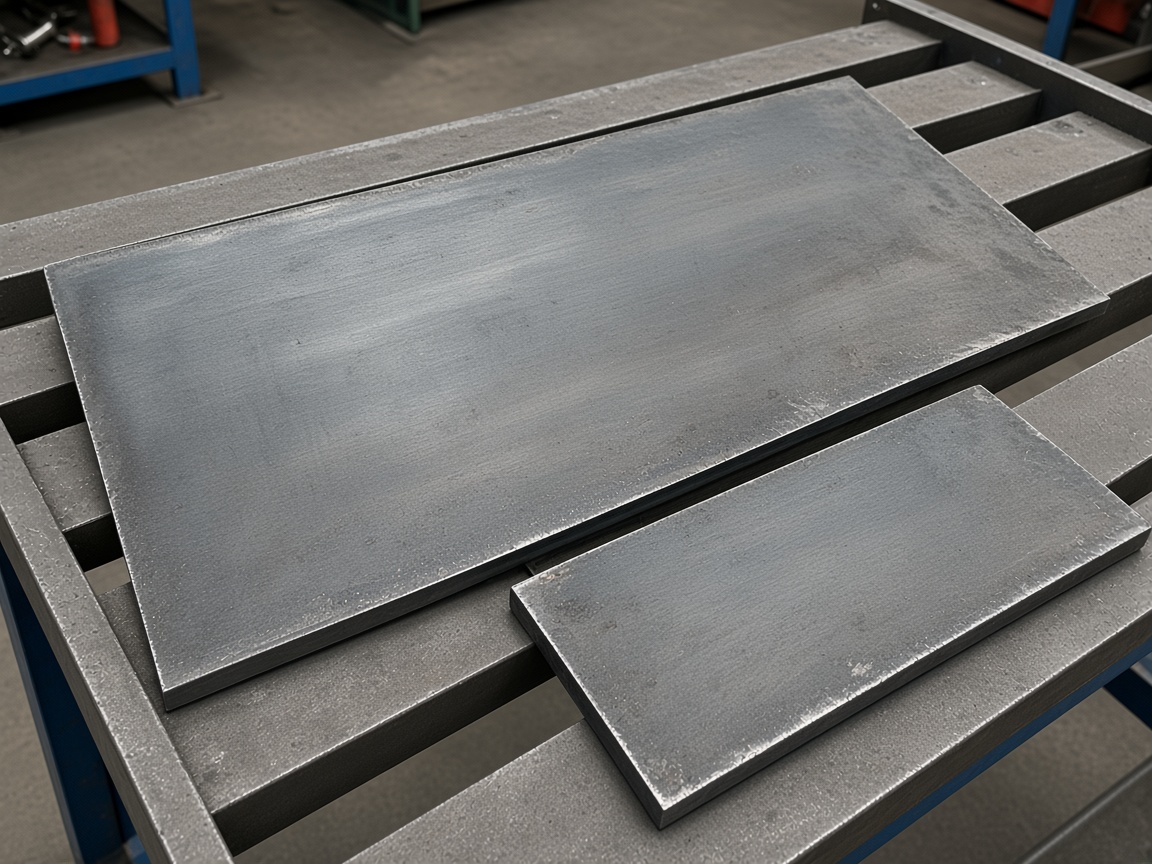
The original generated product-form image is illustrative. Appearance does not identify a steel grade or prove certification.
-

GB/T 24186 NM300-NM600 Abrasion
Overview of GB/T 24186 NM300 to NM600 abrasion resistant steel grades with links to each canonical Gangsteel pr
-

WNM vs NM Wear Plate: What WNM3
What WNM360L means vs GB/T 24186 NM360 for buyers: brand naming, MTC checks and when to order the canonical NM
-

Cutting and Bending NM500 Wear
Buyer guide to cutting and bending NM500 wear plate: plasma, flame, waterjet, bend radius and edge softening no
-

Welding NM400 Wear Plate: Prehe
Practical welding notes for NM400 wear plate: preheat, consumables, cracking risks and backing to mild steel. S