


Steel Angles
Q355B Angles: GB/T 706 Equal & Unequal Sizes
Q355B equal and unequal angles are hot-rolled L-sections whose material is specified to GB/T 1591-2018 and whose rolled shape follows GB/T 706. This page combines the two leg arrangements for one material quality; it does not extend Q355B to every shape that resembles an angle. Bent plate, unequal-thickness special sections and shipbuilding bulb profiles need their own product scope.
For angle bracing, a higher nominal yield can shift the controlling check from gross-section tension to the connection, net area or buckling resistance. A thick Q355B angle also crosses material thickness boundaries that a thin angle does not. The tables below therefore keep leg thickness visible alongside geometry and explain both the 16 mm yield threshold and the 30 mm carbon/CEV threshold.
| Order field | Scope |
|---|---|
| Product | Q355B equal and unequal steel angles |
| Material standard | GB/T 1591-2018 hot-rolled route |
| Section/product standard | GB/T 706: shape series, dimensions, tolerances and rolled-product requirements; numerical basis here 2016 |
| Delivery condition | Hot rolled; no normalized or TMCP route implied |
| Certification | Identify grade, heat/batch traceability, dimensional edition and agreed test reporting |
The numerical size tables on this page use GB/T 706-2016. On 22 November 2026 this is the effective edition. GB/T 706-2026 has been issued but does not take effect until 1 December 2026. These are not 2026-edition dimension tables. Specify the contractual dimensional edition, including its tolerances and mass basis, rather than silently applying a later edition to an earlier catalogue.
Selection and connection engineering
Use leg thickness to separate thin braces from heavy angles
For these rolled L-sections, the ordinary material-thickness reference is the leg thickness d, not B or b. A 250 × 250 × 35 angle is a 35 mm-thick material case even though both legs are 250 mm wide. It lies in the 345 MPa yield band and above the 30 mm carbon/CEV boundary. The 32 mm row crosses the same chemistry boundary; a 30 mm row does not.
Look beyond gross yielding in a high-strength tension member
The effective net section, bolt-hole layout, block tearing and shear lag may govern a Q355B angle connected through one leg. Define the connection length and load transfer rather than multiplying gross area by 355 MPa. If the connection or stiffness governs, increasing the grade may give little useful benefit. Any change of bolt line or connected leg requires a new detail check.
Use principal-axis and flexural-torsional stability checks
An angle brace under compression can be sensitive to its weak principal axis and to eccentric end connections. The free-leg width-to-thickness ratio and actual restraint affect the selected design model. Equal and unequal angles cannot share a single assumed radius of gyration. A higher steel yield does not alter the section geometry or eliminate connection eccentricity.
Control heat chemistry and welded-node restraint together
For 32 and 35 mm equal-angle legs the relevant heat carbon limit is 0.22% and the CEV ceiling is 0.47%, rather than the thinner-band values. Use the actual heat analysis and the weld procedure to assess preheat and hydrogen control. The compositional ceiling is not a preheat instruction, and a material certificate does not by itself qualify a highly restrained gusset-node weld.
Mechanical properties: identify the tested thickness
| Nominal material thickness | Minimum ReH, MPa | Rm, MPa | Minimum A, % |
|---|---|---|---|
| d ≤16 mm | 355 | 470–630 | 22 |
| 16 < d ≤40 mm | 345 | 470–630 | 22 |
For these tables d denotes the applicable material-thickness reference: ordinarily the web in I-sections/channels and the leg in angles. It is not the overall height or leg width. Elongation values are the section/bar longitudinal reference; plate-specific specimen orientation or deductions must not be imported unchanged. Final specimen position, direction and preparation follow the ordered standards and contract, including GB/T 2975. These two bands cover the supplied reference series; they do not authorize other heavy-section products.
The angle leg thickness d is the ordinary material reference. The largest listed leg is 35 mm, so the series spans the first two yield bands but not the >40 mm band. Widths such as 200 or 250 mm do not select the material thickness band. Unequal leg widths do not imply unequal leg thicknesses.
| Temperature | Longitudinal KV2 | Transverse option | Thickness qualification |
|---|---|---|---|
| +20 °C | 34 J | 27 J by agreement | Ordinary nominal-thickness trigger ≥6 mm; specimen size and energy acceptance follow the standard. |
Several light angles have legs thinner than 6 mm. Do not promise a full-size 10 × 10 mm impact specimen from a thinner section. Agree the applicable reduced-size specimen and energy rules where needed; below-trigger material is not automatically evidence of measured toughness. The 34 J figure is the longitudinal full-size reference, not a universal value for every specimen orientation or size. This +20 °C B quality does not establish cold-service suitability.
Heat chemistry and finished-product analysis
| Element | Limit | Acceptance note |
|---|---|---|
| C | 0.24 | For nominal material thickness >30 mm, maximum 0.22; this page does not apply the special >100 mm agreement route. |
| Si | 0.55 | Any restricted-silicon order needs its own agreed chemistry and applicable footnotes. |
| Mn | 1.60 | Heat-analysis maximum. |
| P | 0.035 | Sections/bars may use the standard’s +0.005 allowance, giving 0.040. |
| S | 0.035 | Sections/bars may use the standard’s +0.005 allowance, giving 0.040. |
| Cr | 0.30 | Heat-analysis maximum. |
| Ni | 0.30 | Heat-analysis maximum. |
| Cu | 0.40 | Heat-analysis maximum. |
| N | 0.012 | Analysis may be omitted with supplier guarantee. The limit is not restrictive with acid-soluble Al ≥0.015%, total Al ≥0.020%, or other nitrogen-binding additions; report the applicable basis. |
| Nb / V / Ti | Not mandatory | Q355 does not require a fixed microalloy addition in this table. Agreed alloy additions must be identified on the certificate. |
These values are for the hot-rolled Q355B route, not the separate normalized or thermomechanically rolled tables. A dash or absent mandatory addition is not a zero-content guarantee. The section/bar P and S allowance must not be concealed by quoting 0.035 as an unconditional rejection limit.
Keep heat analysis and product analysis distinct. Heat/ladle results identify the melt; a test on the finished rolled section is product analysis and is assessed using the applicable GB/T 222 permitted-deviation provisions. No numerical product-analysis deviations are supplied by the compiled dataset, so no extra tolerance has been invented here. If product analysis is required, agree the sampling, test method, material edition and deviation table before ordering; do not add a discretionary percentage to every heat limit.
Carbon equivalent: use the correct thickness and delivery route
| Nominal material thickness | Maximum CEV, % |
|---|---|
| ≤30 mm | 0.45 |
| >30–40 mm | 0.47 |
CEV = C + Mn/6 + (Cr + Mo + V)/5 + (Ni + Cu)/15, using mass percentages from the heat analysis. These are the GB/T 1591-2018 hot-rolled route values, not Q355N/Q355M limits. Restricted-silicon chemistry may invoke particular standard footnotes; no blanket increase has been applied to this table. A CEV ceiling is a composition control, not a weld procedure or an automatic no-preheat guarantee.
The 250 × 250 × 32 and 250 × 250 × 35 equal-angle rows exceed 30 mm leg thickness: their applicable carbon maximum is 0.22% and CEV maximum is 0.47%. All the other listed legs are at or below 30 mm. This boundary is separate from the 16 mm yield boundary: a 20 mm leg is already in the lower yield band while still in the 0.45 CEV band.
GB/T 706-2016 dimensions and theoretical mass
All dimensions are millimetres; A is cross-sectional area in cm² and mass is kg/m. The values are a reference series, not a stock list or a guarantee that every size/grade combination can be supplied on a particular enquiry. Confirm the actual section, length, quantity and certification requirement. The tabulated mass is retained on its published 2016 basis rather than reconstructed from rounded area values. Dimensional, shape and mass tolerances must be taken from the contracted edition, not from the number of decimal places below.
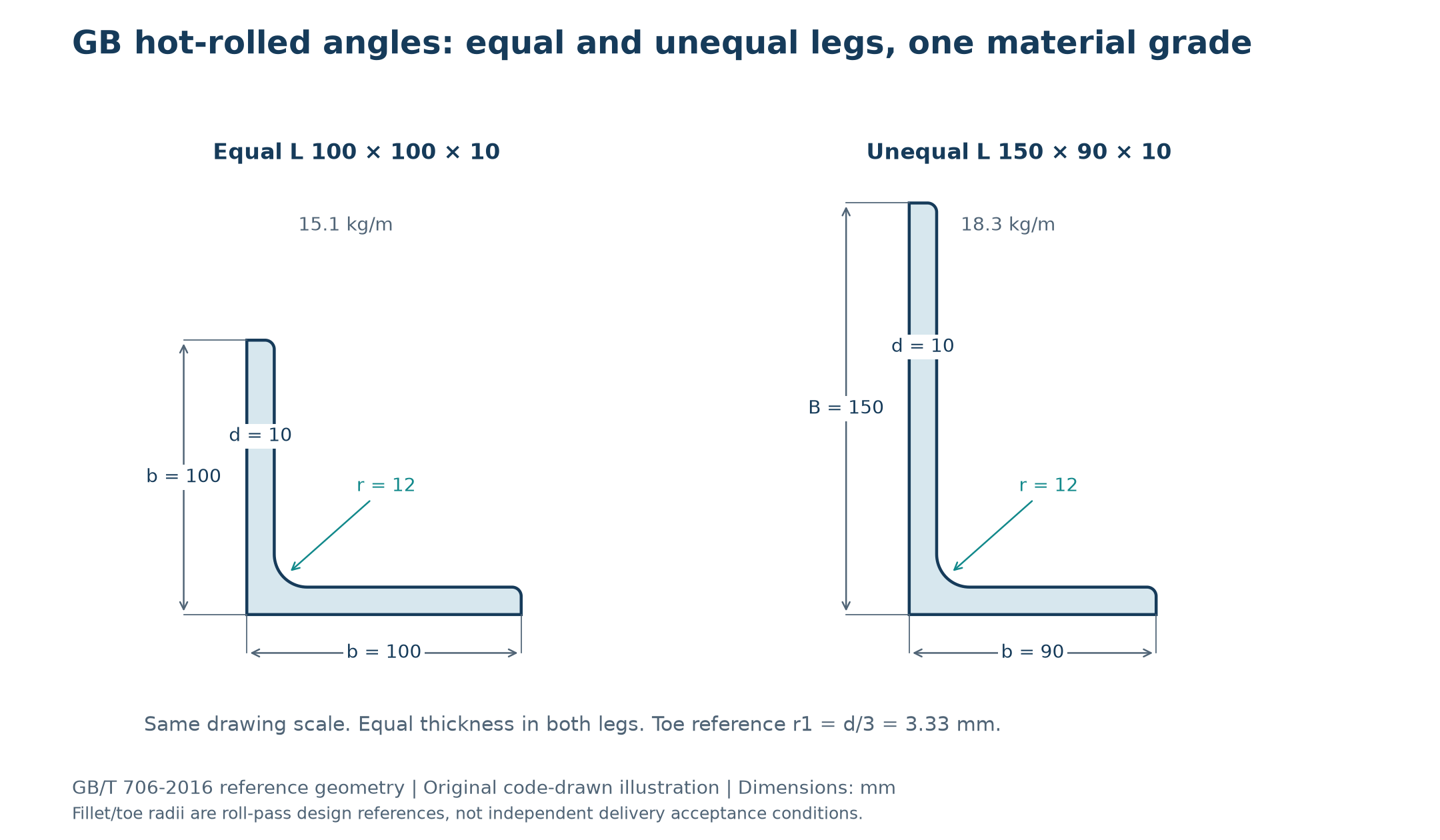
Equal-leg dimensions use b × b × d. Unequal-leg dimensions use B × b × d, with B the long leg and b the short leg. Both legs have the same nominal thickness d in this scope. The yield column uses that leg thickness; the dimensions are not EN 10056 or JIS dimensions relabelled as GB.
| Model | b × b × d | b mm | d mm | A cm² | kg/m | Leg-band ReH min, MPa |
|---|---|---|---|---|---|---|
| 2 | 20×20×3 | 20 | 3 | 1.132 | 0.89 | 355 |
| 2 | 20×20×4 | 20 | 4 | 1.459 | 1.15 | 355 |
| 2.5 | 25×25×3 | 25 | 3 | 1.432 | 1.12 | 355 |
| 2.5 | 25×25×4 | 25 | 4 | 1.859 | 1.46 | 355 |
| 3 | 30×30×3 | 30 | 3 | 1.749 | 1.37 | 355 |
| 3 | 30×30×4 | 30 | 4 | 2.276 | 1.79 | 355 |
| 3.6 | 36×36×3 | 36 | 3 | 2.109 | 1.66 | 355 |
| 3.6 | 36×36×4 | 36 | 4 | 2.756 | 2.16 | 355 |
| 3.6 | 36×36×5 | 36 | 5 | 3.382 | 2.65 | 355 |
| 4 | 40×40×3 | 40 | 3 | 2.359 | 1.85 | 355 |
| 4 | 40×40×4 | 40 | 4 | 3.086 | 2.42 | 355 |
| 4 | 40×40×5 | 40 | 5 | 3.792 | 2.98 | 355 |
| 4.5 | 45×45×3 | 45 | 3 | 2.659 | 2.09 | 355 |
| 4.5 | 45×45×4 | 45 | 4 | 3.486 | 2.74 | 355 |
| 4.5 | 45×45×5 | 45 | 5 | 4.292 | 3.37 | 355 |
| 4.5 | 45×45×6 | 45 | 6 | 5.077 | 3.99 | 355 |
| 5 | 50×50×3 | 50 | 3 | 2.971 | 2.33 | 355 |
| 5 | 50×50×4 | 50 | 4 | 3.897 | 3.06 | 355 |
| 5 | 50×50×5 | 50 | 5 | 4.803 | 3.77 | 355 |
| 5 | 50×50×6 | 50 | 6 | 5.688 | 4.46 | 355 |
| 5.6 | 56×56×3 | 56 | 3 | 3.343 | 2.62 | 355 |
| 5.6 | 56×56×4 | 56 | 4 | 4.39 | 3.45 | 355 |
| 5.6 | 56×56×5 | 56 | 5 | 5.415 | 4.25 | 355 |
| 5.6 | 56×56×6 | 56 | 6 | 6.42 | 5.04 | 355 |
| 5.6 | 56×56×7 | 56 | 7 | 7.404 | 5.81 | 355 |
| 5.6 | 56×56×8 | 56 | 8 | 8.367 | 6.57 | 355 |
| 6 | 60×60×5 | 60 | 5 | 5.829 | 4.58 | 355 |
| 6 | 60×60×6 | 60 | 6 | 6.914 | 5.43 | 355 |
| 6 | 60×60×7 | 60 | 7 | 7.977 | 6.26 | 355 |
| 6 | 60×60×8 | 60 | 8 | 9.02 | 7.08 | 355 |
| 6.3 | 63×63×4 | 63 | 4 | 4.978 | 3.91 | 355 |
| 6.3 | 63×63×5 | 63 | 5 | 6.143 | 4.82 | 355 |
| 6.3 | 63×63×6 | 63 | 6 | 7.288 | 5.72 | 355 |
| 6.3 | 63×63×7 | 63 | 7 | 8.412 | 6.60 | 355 |
| 6.3 | 63×63×8 | 63 | 8 | 9.515 | 7.47 | 355 |
| 6.3 | 63×63×10 | 63 | 10 | 11.66 | 9.15 | 355 |
| 7 | 70×70×4 | 70 | 4 | 5.570 | 4.37 | 355 |
| 7 | 70×70×5 | 70 | 5 | 6.876 | 5.40 | 355 |
| 7 | 70×70×6 | 70 | 6 | 8.160 | 6.41 | 355 |
| 7 | 70×70×7 | 70 | 7 | 9.424 | 7.40 | 355 |
| 7 | 70×70×8 | 70 | 8 | 10.67 | 8.37 | 355 |
| 7.5 | 75×75×5 | 75 | 5 | 7.412 | 5.82 | 355 |
| 7.5 | 75×75×6 | 75 | 6 | 8.797 | 6.91 | 355 |
| 7.5 | 75×75×7 | 75 | 7 | 10.16 | 7.98 | 355 |
| 7.5 | 75×75×8 | 75 | 8 | 11.50 | 9.03 | 355 |
| 7.5 | 75×75×9 | 75 | 9 | 12.83 | 10.1 | 355 |
| 7.5 | 75×75×10 | 75 | 10 | 14.13 | 11.1 | 355 |
| 8 | 80×80×5 | 80 | 5 | 7.912 | 6.21 | 355 |
| 8 | 80×80×6 | 80 | 6 | 9.397 | 7.38 | 355 |
| 8 | 80×80×7 | 80 | 7 | 10.86 | 8.53 | 355 |
| 8 | 80×80×8 | 80 | 8 | 12.30 | 9.66 | 355 |
| 8 | 80×80×9 | 80 | 9 | 13.73 | 10.8 | 355 |
| 8 | 80×80×10 | 80 | 10 | 15.13 | 11.9 | 355 |
| 9 | 90×90×6 | 90 | 6 | 10.64 | 8.35 | 355 |
| 9 | 90×90×7 | 90 | 7 | 12.30 | 9.66 | 355 |
| 9 | 90×90×8 | 90 | 8 | 13.94 | 10.9 | 355 |
| 9 | 90×90×9 | 90 | 9 | 15.57 | 12.2 | 355 |
| 9 | 90×90×10 | 90 | 10 | 17.17 | 13.5 | 355 |
| 9 | 90×90×12 | 90 | 12 | 20.31 | 15.9 | 355 |
| 10 | 100×100×6 | 100 | 6 | 11.93 | 9.37 | 355 |
| 10 | 100×100×7 | 100 | 7 | 13.80 | 10.8 | 355 |
| 10 | 100×100×8 | 100 | 8 | 15.64 | 12.3 | 355 |
| 10 | 100×100×9 | 100 | 9 | 17.46 | 13.7 | 355 |
| 10 | 100×100×10 | 100 | 10 | 19.26 | 15.1 | 355 |
| 10 | 100×100×12 | 100 | 12 | 22.80 | 17.9 | 355 |
| 10 | 100×100×14 | 100 | 14 | 26.26 | 20.6 | 355 |
| 10 | 100×100×16 | 100 | 16 | 29.63 | 23.3 | 355 |
| 11 | 110×110×7 | 110 | 7 | 15.20 | 11.9 | 355 |
| 11 | 110×110×8 | 110 | 8 | 17.24 | 13.5 | 355 |
| 11 | 110×110×10 | 110 | 10 | 21.26 | 16.7 | 355 |
| 11 | 110×110×12 | 110 | 12 | 25.20 | 19.8 | 355 |
| 11 | 110×110×14 | 110 | 14 | 29.06 | 22.8 | 355 |
| 12.5 | 125×125×8 | 125 | 8 | 19.75 | 15.5 | 355 |
| 12.5 | 125×125×10 | 125 | 10 | 24.37 | 19.1 | 355 |
| 12.5 | 125×125×12 | 125 | 12 | 28.91 | 22.7 | 355 |
| 12.5 | 125×125×14 | 125 | 14 | 33.37 | 26.2 | 355 |
| 12.5 | 125×125×16 | 125 | 16 | 37.74 | 29.6 | 355 |
| 14 | 140×140×10 | 140 | 10 | 27.37 | 21.5 | 355 |
| 14 | 140×140×12 | 140 | 12 | 32.51 | 25.5 | 355 |
| 14 | 140×140×14 | 140 | 14 | 37.57 | 29.5 | 355 |
| 14 | 140×140×16 | 140 | 16 | 42.54 | 33.4 | 355 |
| 15 | 150×150×8 | 150 | 8 | 23.75 | 18.6 | 355 |
| 15 | 150×150×10 | 150 | 10 | 29.37 | 23.1 | 355 |
| 15 | 150×150×12 | 150 | 12 | 34.91 | 27.4 | 355 |
| 15 | 150×150×14 | 150 | 14 | 40.37 | 31.7 | 355 |
| 15 | 150×150×15 | 150 | 15 | 43.06 | 33.8 | 355 |
| 15 | 150×150×16 | 150 | 16 | 45.74 | 35.9 | 355 |
| 16 | 160×160×10 | 160 | 10 | 31.50 | 24.7 | 355 |
| 16 | 160×160×12 | 160 | 12 | 37.44 | 29.4 | 355 |
| 16 | 160×160×14 | 160 | 14 | 43.30 | 34.0 | 355 |
| 16 | 160×160×16 | 160 | 16 | 49.07 | 38.5 | 355 |
| 18 | 180×180×12 | 180 | 12 | 42.24 | 33.2 | 355 |
| 18 | 180×180×14 | 180 | 14 | 48.90 | 38.4 | 355 |
| 18 | 180×180×16 | 180 | 16 | 55.47 | 43.5 | 355 |
| 18 | 180×180×18 | 180 | 18 | 61.96 | 48.6 | 345 |
| 20 | 200×200×14 | 200 | 14 | 54.64 | 42.9 | 355 |
| 20 | 200×200×16 | 200 | 16 | 62.01 | 48.7 | 355 |
| 20 | 200×200×18 | 200 | 18 | 69.30 | 54.4 | 345 |
| 20 | 200×200×20 | 200 | 20 | 76.51 | 60.1 | 345 |
| 20 | 200×200×24 | 200 | 24 | 90.66 | 71.2 | 345 |
| 22 | 220×220×16 | 220 | 16 | 68.67 | 53.9 | 355 |
| 22 | 220×220×18 | 220 | 18 | 76.75 | 60.3 | 345 |
| 22 | 220×220×20 | 220 | 20 | 84.76 | 66.5 | 345 |
| 22 | 220×220×22 | 220 | 22 | 92.68 | 72.8 | 345 |
| 22 | 220×220×24 | 220 | 24 | 100.5 | 78.9 | 345 |
| 22 | 220×220×26 | 220 | 26 | 108.3 | 85.0 | 345 |
| 25 | 250×250×18 | 250 | 18 | 87.84 | 69.0 | 345 |
| 25 | 250×250×20 | 250 | 20 | 97.05 | 76.2 | 345 |
| 25 | 250×250×22 | 250 | 22 | 106.2 | 83.3 | 345 |
| 25 | 250×250×24 | 250 | 24 | 115.2 | 90.4 | 345 |
| 25 | 250×250×26 | 250 | 26 | 124.2 | 97.5 | 345 |
| 25 | 250×250×28 | 250 | 28 | 133.0 | 104 | 345 |
| 25 | 250×250×30 | 250 | 30 | 141.8 | 111 | 345 |
| 25 | 250×250×32 | 250 | 32 | 150.5 | 118 | 345 |
| 25 | 250×250×35 | 250 | 35 | 163.4 | 128 | 345 |
| Model | B × b × d | B mm | b mm | d mm | A cm² | kg/m | Leg-band ReH min, MPa |
|---|---|---|---|---|---|---|---|
| 2.5/1.6 | 25×16×3 | 25 | 16 | 3 | 1.152 | 0.91 | 355 |
| 2.5/1.6 | 25×16×4 | 25 | 16 | 4 | 1.499 | 1.18 | 355 |
| 3.2/2 | 32×20×3 | 32 | 20 | 3 | 1.492 | 1.17 | 355 |
| 3.2/2 | 32×20×4 | 32 | 20 | 4 | 1.939 | 1.52 | 355 |
| 4/2.5 | 40×25×3 | 40 | 25 | 3 | 1.890 | 1.48 | 355 |
| 4/2.5 | 40×25×4 | 40 | 25 | 4 | 2.467 | 1.94 | 355 |
| 4.5/2.8 | 45×28×3 | 45 | 28 | 3 | 2.149 | 1.69 | 355 |
| 4.5/2.8 | 45×28×4 | 45 | 28 | 4 | 2.806 | 2.20 | 355 |
| 5/3.2 | 50×32×3 | 50 | 32 | 3 | 2.431 | 1.91 | 355 |
| 5/3.2 | 50×32×4 | 50 | 32 | 4 | 3.177 | 2.49 | 355 |
| 5.6/3.6 | 56×36×3 | 56 | 36 | 3 | 2.743 | 2.15 | 355 |
| 5.6/3.6 | 56×36×4 | 56 | 36 | 4 | 3.590 | 2.82 | 355 |
| 5.6/3.6 | 56×36×5 | 56 | 36 | 5 | 4.415 | 3.47 | 355 |
| 6.3/4 | 65×40×4 | 65 | 40 | 4 | 4.058 | 3.19 | 355 |
| 6.3/4 | 65×40×5 | 65 | 40 | 5 | 4.993 | 3.92 | 355 |
| 6.3/4 | 65×40×6 | 65 | 40 | 6 | 5.908 | 4.64 | 355 |
| 6.3/4 | 65×40×7 | 65 | 40 | 7 | 6.802 | 5.34 | 355 |
| 7/4.5 | 70×45×4 | 70 | 45 | 4 | 4.553 | 3.57 | 355 |
| 7/4.5 | 70×45×5 | 70 | 45 | 5 | 5.609 | 4.40 | 355 |
| 7/4.5 | 70×45×6 | 70 | 45 | 6 | 6.644 | 5.22 | 355 |
| 7/4.5 | 70×45×7 | 70 | 45 | 7 | 7.658 | 6.01 | 355 |
| 7.5/5 | 75×50×5 | 75 | 50 | 5 | 6.136 | 4.81 | 355 |
| 7.5/5 | 75×50×6 | 75 | 50 | 6 | 7.260 | 5.70 | 355 |
| 7.5/5 | 75×50×8 | 75 | 50 | 8 | 9.467 | 7.43 | 355 |
| 7.5/5 | 75×50×10 | 75 | 50 | 10 | 11.59 | 9.10 | 355 |
| 8/5 | 80×50×5 | 80 | 50 | 5 | 6.376 | 5.00 | 355 |
| 8/5 | 80×50×6 | 80 | 50 | 6 | 7.560 | 5.93 | 355 |
| 8/5 | 80×50×7 | 80 | 50 | 7 | 8.724 | 6.85 | 355 |
| 8/5 | 80×50×8 | 80 | 50 | 8 | 9.867 | 7.75 | 355 |
| 9/5.6 | 90×56×5 | 90 | 56 | 5 | 7.212 | 5.66 | 355 |
| 9/5.6 | 90×56×6 | 90 | 56 | 6 | 8.557 | 6.72 | 355 |
| 9/5.6 | 90×56×7 | 90 | 56 | 7 | 9.880 | 7.76 | 355 |
| 9/5.6 | 90×56×8 | 90 | 56 | 8 | 11.18 | 8.78 | 355 |
| 10/6.3 | 100×63×6 | 100 | 63 | 6 | 9.618 | 7.55 | 355 |
| 10/6.3 | 100×63×7 | 100 | 63 | 7 | 11.11 | 8.72 | 355 |
| 10/6.3 | 100×63×8 | 100 | 63 | 8 | 12.58 | 9.88 | 355 |
| 10/6.3 | 100×63×10 | 100 | 63 | 10 | 15.47 | 12.1 | 355 |
| 10/8 | 100×80×6 | 100 | 80 | 6 | 10.64 | 8.35 | 355 |
| 10/8 | 100×80×7 | 100 | 80 | 7 | 12.30 | 9.66 | 355 |
| 10/8 | 100×80×8 | 100 | 80 | 8 | 13.94 | 10.9 | 355 |
| 10/8 | 100×80×10 | 100 | 80 | 10 | 17.17 | 13.5 | 355 |
| 11/7 | 110×70×6 | 110 | 70 | 6 | 10.64 | 8.35 | 355 |
| 11/7 | 110×70×7 | 110 | 70 | 7 | 12.30 | 9.66 | 355 |
| 11/7 | 110×70×8 | 110 | 70 | 8 | 13.94 | 10.9 | 355 |
| 11/7 | 110×70×10 | 110 | 70 | 10 | 17.17 | 13.5 | 355 |
| 12.5/8 | 125×80×7 | 125 | 80 | 7 | 14.10 | 11.1 | 355 |
| 12.5/8 | 125×80×8 | 125 | 80 | 8 | 15.99 | 12.6 | 355 |
| 12.5/8 | 125×80×10 | 125 | 80 | 10 | 19.71 | 15.5 | 355 |
| 12.5/8 | 125×80×12 | 125 | 80 | 12 | 23.35 | 18.3 | 355 |
| 14/9 | 140×90×8 | 140 | 90 | 8 | 18.04 | 14.2 | 355 |
| 14/9 | 140×90×10 | 140 | 90 | 10 | 22.26 | 17.5 | 355 |
| 14/9 | 140×90×12 | 140 | 90 | 12 | 26.40 | 20.7 | 355 |
| 14/9 | 140×90×14 | 140 | 90 | 14 | 30.46 | 23.9 | 355 |
| 15/9 | 150×90×8 | 150 | 90 | 8 | 18.84 | 14.8 | 355 |
| 15/9 | 150×90×10 | 150 | 90 | 10 | 23.26 | 18.3 | 355 |
| 15/9 | 150×90×12 | 150 | 90 | 12 | 27.60 | 21.7 | 355 |
| 15/9 | 150×90×14 | 150 | 90 | 14 | 31.86 | 25.0 | 355 |
| 15/9 | 150×90×15 | 150 | 90 | 15 | 33.95 | 26.7 | 355 |
| 15/9 | 150×90×16 | 150 | 90 | 16 | 36.03 | 28.3 | 355 |
| 16/10 | 160×100×10 | 160 | 100 | 10 | 25.32 | 19.9 | 355 |
| 16/10 | 160×100×12 | 160 | 100 | 12 | 30.05 | 23.6 | 355 |
| 16/10 | 160×100×14 | 160 | 100 | 14 | 34.71 | 27.2 | 355 |
| 16/10 | 160×100×16 | 160 | 100 | 16 | 39.28 | 30.8 | 355 |
| 18/11 | 180×110×10 | 180 | 110 | 10 | 28.37 | 22.3 | 355 |
| 18/11 | 180×110×12 | 180 | 110 | 12 | 33.71 | 26.5 | 355 |
| 18/11 | 180×110×14 | 180 | 110 | 14 | 38.97 | 30.6 | 355 |
| 18/11 | 180×110×16 | 180 | 110 | 16 | 44.14 | 34.6 | 355 |
| 20/12.5 | 200×125×12 | 200 | 125 | 12 | 37.91 | 29.8 | 355 |
| 20/12.5 | 200×125×14 | 200 | 125 | 14 | 43.87 | 34.4 | 355 |
| 20/12.5 | 200×125×16 | 200 | 125 | 16 | 49.74 | 39.0 | 355 |
| 20/12.5 | 200×125×18 | 200 | 125 | 18 | 55.53 | 43.6 | 345 |
Inspection, traceability and enquiry
Check both leg widths, leg thickness, squareness, straightness and twist. Identify the long/short leg orientation for unequal-angle connections. Reference fillet radii do not replace the delivery conditions in the applicable product standard.
- State the full designation, exact grade/material edition, dimensional edition, lengths and quantity; identify any approved deviation from the normal hot-rolled scope.
- Define the documentary requirement before ordering: heat analysis, applicable tensile results, the impact-test regime where required, and traceability between the certificate and supplied bundles. Do not assume a particular third-party certificate or inspection service.
- Specify theoretical or actual-mass settlement and any special dimensional acceptance before quotation. Extra tests, coatings, fabrication or additional delivery conditions are not implied by a general grade enquiry.
Lead time: a typical mill order is about 35 days. Stocked sizes: 1–3 days, subject to enquiry and confirmation of the individual size, grade, quantity and delivery requirement. A tabulated section is not a statement that it is held in stock.
Related section and material comparisons
For a different rolled geometry in the same material, see Q355B H-beams. The Q355B plate material page is a separate product form: it must not replace the section-specific sampling and shape requirements above.
See the hot-rolled angle family overview and S355JR EN equal/unequal angles for other angle references. Confirm the material and dimension systems independently; matching printed legs do not establish equal mass or interchangeable properties.
Compare this GB/T 706 equal and unequal angle family in the other grade: Q235B Angles.
Frequently asked questions
Why are equal and unequal angles on one grade page?
They share the Q-grade material framework and the GB/T 706 angle product family. Separate equal- and unequal-leg dimension tables make the geometry clear without multiplying near-identical material pages. An unequal-leg enquiry still needs both leg sizes and its connected-leg orientation; the combined page is not a statement that the shapes are interchangeable.
Which dimension controls the material thickness band?
Use the nominal leg thickness d for the ordinary angle reference, not the long or short leg width. The sample location and preparation follow the applicable GB/T 2975 requirements. This scope is for equal thickness in both legs, not a special unequal-thickness marine section.
Does a one-leg connection develop the full gross-area strength?
Not automatically. Check the net section, load eccentricity, shear lag or effective-area provisions, bolt-group layout and block tearing under the project code. A load introduced through one leg is not distributed in the same way as a concentric tensile test on a material specimen.
Can the GB table mass be replaced by an EN angle mass?
No. Even at the same nominal leg sizes, root and toe conventions and tabulated rounding can differ. GB100 × 100 × 10 is tabulated at 15.1 kg/m on this basis. Use the ordered GB edition for theoretical-mass settlement and the actual specified section for structural properties, not a visually similar EN catalogue row.
Is Q355B simply the new name for every Q345B product?
No. The 2018 material system replaced the older Q345 grade designation, but a historical certificate does not automatically meet every Q355B chemistry, thickness-band and toughness requirement. Compare the original order and actual test results. The hot-rolled route on this page is also distinct from Q355N and Q355M delivery conditions.
Does the 0.035% P/S table exclude all material above it?
Not unconditionally for sections. The hot-rolled Q355B table permits a +0.005 percentage-point allowance for sections and bars, giving 0.040% for each of P and S. If the project requires 0.035% without that allowance, state the tighter contractual requirement. Do not confuse heat maxima with finished-product analysis deviations.
Does Q355B guarantee 34 J in all directions and at low temperature?
No. The reference is 34 J longitudinal at +20 °C when testing applies. A 27 J transverse option requires agreement, and reduced-size specimen rules can change the applicable acceptance values. B quality does not establish subzero toughness. State the required test temperature, orientation, specimen basis and reporting rather than relying on the B suffix alone.
How should a welding and delivery enquiry be written?
Specify the exact section, Q355B to the hot-rolled GB/T 1591-2018 route, the GB/T 706 dimensional edition, length, quantity and test documentation. Include any restricted chemistry, CEV, actual impact test or finished-product analysis requirement. Provide joint details if welding suitability is being assessed. Typical mill orders are about 35 days; stocked sizes are 1–3 days only subject to individual enquiry confirmation.
For an enquiry to Gangsteel, provide the exact section and material specification, rather than a grade name alone. Quote acceptance remains subject to confirmation of the requested size, quantity and test scope.