


Steel Beams
EN 10025-2 S355JR IPE Beams: Sizes & Properties
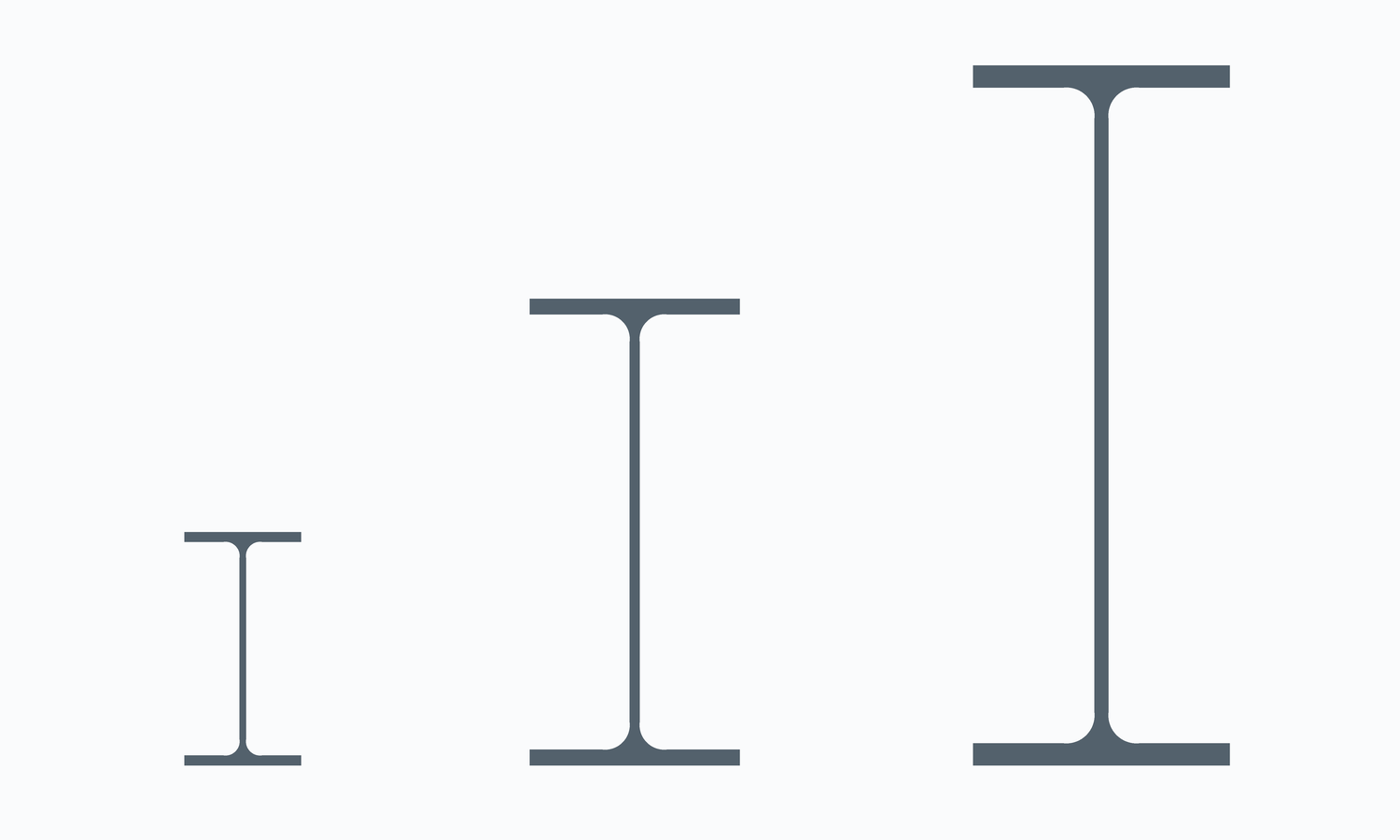
S355JR IPE Beams: Grade and Section in One Order
S355JR IPE beams use the 355 MPa EN 10025-2 grade with a +20 °C impact quality. They suit strength-governed beams in heated or internal structures where a sub-zero impact quality is not required. Gangsteel supplies S355JR IPE beams; quote the full designation, for example “IPE 400, EN 10025-2 S355JR”.
| Item | Value | Note |
|---|---|---|
| Material | EN 10025-2:2019 S355JR (1.0045) | Impact quality 27 J at +20 °C |
| Section series | IPE to EN 10365:2017 | Standard IPE 80–600; IPE A, IPE O and IPE V variants are separate series |
| Tolerances | EN 10034 | Depth, width, thickness, out-of-square, straightness |
| General delivery | EN 10025-1 | Testing, inspection documents, marking |
| Supply | Gangsteel supplies EN 10025-2 S355JR IPE beams | Sizes, quantities and stock confirmed per enquiry |
| Former designation | Fe 510 B (EN 10025:1990) | Historical only |
IPE 80 to IPE 600 in S355JR
| IPE | h mm | b mm | tw mm | tf mm | kg/m | ReH MPa | Wpl,y cm³ | Wpl,y·ReH kNm | Class, axial |
|---|---|---|---|---|---|---|---|---|---|
| IPE 80 | 80.0 | 46.0 | 3.8 | 5.2 | 6.0 | 355 | 23.2 | 8 | Class 1 |
| IPE 100 | 100.0 | 55.0 | 4.1 | 5.7 | 8.1 | 355 | 39.4 | 14 | Class 1 |
| IPE 120 | 120.0 | 64.0 | 4.4 | 6.3 | 10.4 | 355 | 60.7 | 22 | Class 1 |
| IPE 140 | 140.0 | 73.0 | 4.7 | 6.9 | 12.9 | 355 | 88.3 | 31 | Class 1 |
| IPE 160 | 160.0 | 82.0 | 5.0 | 7.4 | 15.8 | 355 | 124 | 44 | Class 1 |
| IPE 180 | 180.0 | 91.0 | 5.3 | 8.0 | 18.8 | 355 | 166 | 59 | Class 2 |
| IPE 200 | 200.0 | 100.0 | 5.6 | 8.5 | 22.4 | 355 | 221 | 78 | Class 2 |
| IPE 220 | 220.0 | 110.0 | 5.9 | 9.2 | 26.2 | 355 | 285 | 101 | Class 2 |
| IPE 240 | 240.0 | 120.0 | 6.2 | 9.8 | 30.7 | 355 | 367 | 130 | Class 2 |
| IPE 270 | 270.0 | 135.0 | 6.6 | 10.2 | 36.1 | 355 | 484 | 172 | Class 3 |
| IPE 300 | 300.0 | 150.0 | 7.1 | 10.7 | 42.2 | 355 | 628 | 223 | Class 4 |
| IPE 330 | 330.0 | 160.0 | 7.5 | 11.5 | 49.1 | 355 | 804 | 285 | Class 4 |
| IPE 360 | 360.0 | 170.0 | 8.0 | 12.7 | 57.1 | 355 | 1,020 | 362 | Class 4 |
| IPE 400 | 400.0 | 180.0 | 8.6 | 13.5 | 66.3 | 355 | 1,310 | 465 | Class 4 |
| IPE 450 | 450.0 | 190.0 | 9.4 | 14.6 | 77.6 | 355 | 1,700 | 604 | Class 4 |
| IPE 500 | 500.0 | 200.0 | 10.2 | 16.0 | 90.7 | 355 | 2,190 | 777 | Class 4 |
| IPE 550 | 550.0 | 210.0 | 11.1 | 17.2 | 106 | 345 | 2,790 | 963 | Class 4 |
| IPE 600 | 600.0 | 220.0 | 12.0 | 19.0 | 122 | 345 | 3,510 | 1211 | Class 4 |
IPE 80 to IPE 500 are in the 355 MPa band; IPE 550 and IPE 600 are at 345 MPa. With ε = 0.81, the slender webs of deeper IPE sizes fall into higher classes in pure compression than in S235 or S275: only 5 of 18 sizes are Class 1 for axial load. In major-axis bending every size is still Class 1, which is why S355 IPE is used mainly for beams rather than struts.
Wpl,y·ReH is the characteristic plastic moment of the cross-section about the major axis, using the S355JR yield band for that flange thickness. It is a cross-section value only: it excludes partial factors, lateral-torsional buckling, shear interaction and serviceability, and is not a safe working load. The class column applies the EN 1993-1-1 width-to-thickness limits for pure axial compression with ε = √(235/ReH); in pure major-axis bending every standard IPE in this grade is Class 1. Confirm classification with the design code and national annex used on the project.
S355JR Chemistry Limits Relevant to IPE
| Element | Limit |
|---|---|
| C | 0.24 |
| Mn | 1.60 |
| Si | 0.55 |
| P | 0.040 |
| S | 0.040 |
| N | 0.012 (waived with total Al ≥ 0.020% or reported N-binding elements) |
| Cu | 0.55 |
| CEV | 0.45 |
S355JR allows up to 0.24% carbon and 0.45% CEV; because every IPE flange is thinner than 30 mm, the 0.47% CEV step that affects heavy HE B sections never applies to IPE. Phosphorus and sulfur are each 0.040%, and nitrogen is limited to 0.012% unless enough aluminium or other nitrogen-binding elements are reported.
S355JR Tensile and Impact Requirements
| Property | tf ≤ 16 mm (IPE 80–500) | 16 mm < tf ≤ 40 mm (IPE 550, 600) |
|---|---|---|
| Minimum ReH | 355 MPa | 345 MPa |
| Rm | 470–630 MPa | 470–630 MPa |
| Minimum A (L0 = 5.65√S0) | 22% | 22% |
| Charpy V, minimum | 27 J at +20 °C | 27 J at +20 °C |
The +20 °C impact quality applies where specimen thickness allows. IPE 80 and IPE 100 flanges (5.2 and 5.7 mm) are too thin for full-size specimens, so impact reporting for those sizes must be agreed. For exposed or cold structures, the designer may specify S355J2 instead.
Design Notes Specific to S355JR IPE Members
S355 increases the characteristic plastic moment by about 51% over S235 for the same IPE: IPE 400 reaches about 465 kNm (1,310 cm³ × 355 MPa). For restrained beams this can save a serial size, but stiffness is unchanged, so deflection limits and lateral-torsional buckling of long unrestrained spans may still control. Webs are slender relative to the higher yield, so concentrated loads and bearing need checking.
S355JR Compared with Other IPE Grades
| Grade | Key difference | Ordering consequence |
|---|---|---|
| S355J2 | Impact at −20 °C; fully killed; P and S 0.030%; C 0.20% | A JR certificate does not satisfy J2 |
| S275JR | Yield 275/265 MPa; CEV 0.40% | Lower resistance, simpler welding |
| ASTM A992 | W shapes to a different standard system | Not an IPE grade; see ASTM A992 wide flange W-beams |
Fabrication: Welding, Cutting and Coating
With CEV up to 0.45% and carbon up to 0.24%, S355JR IPE needs a qualified welding procedure with attention to hydrogen control; preheat is less often driven by thickness because IPE flanges are at most 19 mm, but restraint matters. The higher carbon allowance than S355J2 can raise heat-affected-zone hardness. Galvanizing chemistry can be agreed as for other JR grades.
Delivery Condition, Inspection and Lead Time
| Item | Specify | Reason |
|---|---|---|
| Delivery condition | +AR or +N where required | Not implied by the grade name |
| Impact test | Whether the 27 J at +20 °C result must be reported, and specimen size for thin flanges | Thin IPE flanges limit specimen size |
| Inspection document | EN 10204 3.1 for heat-specific results | Traceability to the delivered pieces |
| Dimensions | EN 10034 tolerances, lengths and cut list | Nominal values are not tolerances |
| Mass basis | Theoretical or weighed | Avoids invoicing disputes |
Lead time: typical delivery is about 35 days for mill orders, and sizes available from stock can ship in 1–3 days. Stock availability is confirmed size by size at enquiry; the IPE table on this page is reference geometry, not a stock list.
RFQ Checklist
- Full designation such as IPE 300, quantity and lengths.
- EN 10025-2 S355JR with delivery condition and any chemistry options.
- Impact verification and EN 10204 document type.
- Processing (cutting, drilling, blasting, priming), packing and destination.
- Whether stock sizes are preferred for 1–3 day dispatch or a mill order is acceptable.
For heavier wide-flange alternatives in the same grade see EN 10025-2 S355JR HEA and HEB beams. The IPE beam size range and grade overview summarises the IPE series across grades, and connection plates are covered by EN 10025-2 S355JR steel plate. The structural steel sections guide compares section families.
The same IPE series in other EN 10025-2 grades: S235JR IPE beams, S275JR IPE beams, S355J2 IPE beams.
Frequently Asked Questions
Which IPE sizes are rated at 345 MPa in S355JR?
IPE 550 and IPE 600, because their flanges exceed 16 mm. IPE 80 to IPE 500 are rated at 355 MPa.
Does the 0.47% CEV limit affect any IPE size?
No. The 0.47% limit applies above 30 mm nominal thickness, and the thickest standard IPE flange is 19.0 mm. All S355JR IPE sizes are limited to 0.45% CEV.
Why are deep S355 IPE sections a higher class in compression?
The web limits scale with ε = √(235/fy). At 355 MPa the limits are about 19% tighter than at 235 MPa, so the slender webs of deeper IPE sizes exceed the Class 1 and 2 limits for pure compression. In bending they remain Class 1.
Is S355JR or S355J2 better for IPE beams?
They have the same strength. J2 adds a minus 20 °C impact test, fully killed steel and tighter chemistry. Internal heated structures often use JR; exposed or low-temperature structures usually need J2. The designer specifies it.
How quickly can S355JR IPE be supplied?
Stock sizes can ship in 1 to 3 days and mill orders typically take about 35 days. Stock is confirmed per size at enquiry.
Can S355JR IPE replace S235JR IPE of the same size?
Structurally it has more strength, but the substitution changes design values, weld procedures and certificates, and must be accepted by the engineer and purchaser. It does not improve stiffness or deflection.
What does the S355JR IPE certificate need to show?
EN 10025-2 S355JR, heat number, chemistry with CEV, tensile results, any ordered impact results, IPE designation and EN 10204 document type, with heat traceability to the delivered pieces.