


S235JR Angles: Equal and Unequal Legs in One Grade
Gangsteel supplies EN 10025-2 S235JR angles in both forms: equal-leg angles from L 25 × 25 × 3 to L 300 × 300 × 35, and unequal-leg angles from L 100 × 65 × 7 to L 250 × 90 × 16. In this lowest-strength non-alloy grade, angles are typically used for bracing, cleats and connection brackets, shelf and lintel angles, edge trims, ladders, frames and light trusses, where geometry, stiffness or fabrication matters more than yield strength. Order as “L 80 × 80 × 8, EN 10025-2 S235JR”.
| Item | Value | Note |
|---|---|---|
| Material | EN 10025-2:2019 S235JR (1.0038) | Impact quality 27 J at +20 °C |
| Section series | Equal and unequal leg angles to EN 10056-1 | Hot-rolled, rounded root and toe; not for square-root angles |
| Tolerances | EN 10056-2 | Leg length, thickness, out-of-square, straightness, mass |
| General delivery | EN 10025-1 | Testing, inspection documents, marking |
| Supply | Gangsteel supplies EN 10025-2 S235JR equal and unequal angles | Sizes, quantities and stock confirmed per enquiry |
| Former designation | St 37-2 (DIN 17100, withdrawn) | Historical only |
Equal Angles in S235JR: Size Range
| Leg size mm | t mm | kg/m | ReH MPa | Thinnest Class 3 t | Class 4 thicknesses |
|---|---|---|---|---|---|
| L 25 × 25 | 3–4 | 1.12–1.45 | 235 | 3 mm | 0 |
| L 30 × 30 | 3–4 | 1.36–1.78 | 235 | 3 mm | 0 |
| L 35 × 35 | 4–5 | 2.09–2.57 | 235 | 4 mm | 0 |
| L 40 × 40 | 4–6 | 2.42–3.52 | 235 | 4 mm | 0 |
| L 45 × 45 | 3–7 | 2.09–4.6 | 235 | 4 mm | 1 |
| L 50 × 50 | 4–9 | 3.06–6.47 | 235 | 5 mm | 1 |
| L 55 × 55 | 4–6 | 3.38–4.95 | 235 | 5 mm | 1 |
| L 60 × 60 | 4–10 | 3.7–8.69 | 235 | 6 mm | 2 |
| L 63 × 63 | 5–6.5 | 4.82–6.17 | 235 | 6 mm | 1 |
| L 65 × 65 | 4–11 | 4.02–10.3 | 235 | 6 mm | 2 |
| L 70 × 70 | 5–10 | 5.37–10.3 | 235 | 7 mm | 2 |
| L 75 × 75 | 4–10 | 4.65–11.1 | 235 | 7 mm | 3 |
| L 80 × 80 | 5–10 | 6.17–11.9 | 235 | 7 mm | 2 |
| L 90 × 90 | 5–16 | 6.97–20.7 | 235 | 8 mm | 3 |
| L 100 × 100 | 6–18 | 9.26–26.2 | 235 / 225 | 9 mm | 3 |
| L 110 × 110 | 6–14 | 10.2–23.3 | 235 | 10 mm | 4 |
| L 120 × 120 | 7–16 | 12.9–28.3 | 235 | 11 mm | 4 |
| L 130 × 130 | 8–16 | 16–30.8 | 235 | 12 mm | 4 |
| L 140 × 140 | 9–18 | 19.3–37.2 | 235 / 225 | 13 mm | 4 |
| L 150 × 150 | 10–20 | 23–44.2 | 235 / 225 | 14 mm | 4 |
| L 160 × 160 | 12–20 | 29.3–47.3 | 235 / 225 | 14 mm | 2 |
| L 180 × 180 | 13–22 | 35.7–58.6 | 235 / 225 | 16 mm | 3 |
| L 200 × 200 | 12–28 | 36.8–82 | 235 / 225 | 18 mm | 6 |
| L 250 × 250 | 17–35 | 64.4–128 | 225 | 22 mm | 5 |
| L 300 × 300 | 25–35 | 112–154 | 225 | 26 mm | 1 |
The range covers 25 × 25 to 300 × 300 mm. Some sizes and thicknesses are specific to individual mills rather than listed in EN 10056-1, so name the full designation, for example L 100 × 100 × 10, and confirm the size at enquiry.
Equal Angle Properties in S235JR
| Designation | kg/m | A cm² | c cm | Iy = Iz cm⁴ | iv cm | Wel cm³ | ReH MPa | A·ReH kN | Class, axial |
|---|---|---|---|---|---|---|---|---|---|
| L 25 × 25 × 3 | 1.12 | 1.42 | 0.720 | 0.800 | 0.480 | 0.450 | 235 | 33 | Class 3 |
| L 30 × 30 × 3 | 1.36 | 1.74 | 0.840 | 1.40 | 0.580 | 0.650 | 235 | 41 | Class 3 |
| L 35 × 35 × 4 | 2.09 | 2.67 | 1.00 | 2.95 | 0.680 | 1.18 | 235 | 63 | Class 3 |
| L 40 × 40 × 4 | 2.42 | 3.08 | 1.12 | 4.47 | 0.780 | 1.55 | 235 | 72 | Class 3 |
| L 45 × 45 × 4.5 | 3.06 | 3.90 | 1.25 | 7.14 | 0.870 | 2.20 | 235 | 92 | Class 3 |
| L 50 × 50 × 5 | 3.77 | 4.80 | 1.40 | 11.0 | 0.970 | 3.05 | 235 | 113 | Class 3 |
| L 55 × 55 × 6 | 4.95 | 6.31 | 1.56 | 17.3 | 1.06 | 4.39 | 235 | 148 | Class 3 |
| L 60 × 60 × 6 | 5.42 | 6.91 | 1.69 | 22.8 | 1.17 | 5.29 | 235 | 162 | Class 3 |
| L 63 × 63 × 6.5 | 6.17 | 7.85 | 1.78 | 28.4 | 1.22 | 6.27 | 235 | 184 | Class 3 |
| L 65 × 65 × 7 | 6.83 | 8.70 | 1.85 | 33.4 | 1.26 | 7.18 | 235 | 204 | Class 3 |
| L 70 × 70 × 7 | 7.38 | 9.40 | 1.97 | 42.3 | 1.36 | 8.41 | 235 | 221 | Class 3 |
| L 75 × 75 × 8 | 8.99 | 11.4 | 2.14 | 59.1 | 1.46 | 11.0 | 235 | 268 | Class 3 |
| L 80 × 80 × 8 | 9.63 | 12.3 | 2.26 | 72.2 | 1.56 | 12.6 | 235 | 289 | Class 3 |
| L 90 × 90 × 9 | 12.2 | 15.5 | 2.54 | 116 | 1.76 | 17.9 | 235 | 364 | Class 3 |
| L 100 × 100 × 10 | 15.0 | 19.2 | 2.82 | 177 | 1.95 | 24.6 | 235 | 451 | Class 3 |
| L 110 × 110 × 11 | 18.2 | 23.2 | 3.11 | 259 | 2.14 | 32.8 | 235 | 545 | Class 3 |
| L 120 × 120 × 12 | 21.6 | 27.5 | 3.40 | 368 | 2.35 | 42.7 | 235 | 646 | Class 3 |
| L 130 × 130 × 13 | 25.4 | 32.3 | 3.68 | 506 | 2.54 | 54.4 | 235 | 759 | Class 3 |
| L 140 × 140 × 14 | 29.4 | 37.5 | 3.96 | 681 | 2.73 | 67.9 | 235 | 881 | Class 3 |
| L 150 × 150 × 15 | 33.8 | 43.0 | 4.25 | 898 | 2.93 | 83.5 | 235 | 1010 | Class 3 |
| L 160 × 160 × 16 | 38.4 | 49.0 | 4.53 | 1,160 | 3.12 | 101 | 235 | 1152 | Class 3 |
| L 180 × 180 × 18 | 48.6 | 61.9 | 5.10 | 1,870 | 3.52 | 145 | 225 | 1393 | Class 3 |
| L 200 × 200 × 20 | 59.9 | 76.3 | 5.68 | 2,850 | 3.92 | 199 | 225 | 1717 | Class 3 |
| L 250 × 250 × 25 | 93.2 | 119.0 | 7.11 | 6,920 | 4.89 | 387 | 225 | 2678 | Class 3 |
| L 300 × 300 × 30 | 133 | 170.0 | 8.54 | 14,300 | 5.86 | 666 | 225 | 3825 | Class 3 |
Unequal Angles in S235JR
| Designation | kg/m | A cm² | cy cm | cz cm | Iy cm⁴ | Iz cm⁴ | iv cm | tan α | ReH MPa | A·ReH kN | Class, axial |
|---|---|---|---|---|---|---|---|---|---|---|---|
| L 100 × 65 × 7 | 8.77 | 11.2 | 3.23 | 1.51 | 113 | 37.6 | 1.40 | 0.415 | 235 | 263 | Class 4 |
| L 100 × 65 × 8 | 9.94 | 12.7 | 3.27 | 1.55 | 127 | 42.2 | 1.40 | 0.413 | 235 | 298 | Class 3 |
| L 100 × 65 × 9 | 11.1 | 14.1 | 3.32 | 1.59 | 141 | 46.7 | 1.39 | 0.412 | 235 | 331 | Class 3 |
| L 100 × 65 × 10 | 12.3 | 15.6 | 3.36 | 1.63 | 154 | 51.0 | 1.39 | 0.410 | 235 | 367 | Class 3 |
| L 100 × 65 × 11 | 13.4 | 17.0 | 3.40 | 1.67 | 167 | 55.1 | 1.38 | 0.408 | 235 | 400 | Class 3 |
| L 100 × 65 × 12 | 14.5 | 18.5 | 3.44 | 1.71 | 180 | 59.1 | 1.38 | 0.406 | 235 | 435 | Class 3 |
| L 110 × 70 × 10 | 13.4 | 17.1 | 3.69 | 1.72 | 207 | 65.1 | 1.50 | 0.396 | 235 | 402 | Class 3 |
| L 110 × 70 × 12 | 15.9 | 20.3 | 3.77 | 1.79 | 242 | 75.5 | 1.49 | 0.392 | 235 | 477 | Class 3 |
| L 120 × 80 × 8 | 12.2 | 15.5 | 3.83 | 1.87 | 226 | 80.8 | 1.74 | 0.437 | 235 | 364 | Class 4 |
| L 120 × 80 × 10 | 15.0 | 19.1 | 3.92 | 1.95 | 276 | 98.1 | 1.72 | 0.435 | 235 | 449 | Class 3 |
| L 120 × 80 × 12 | 17.8 | 22.7 | 4.00 | 2.03 | 323 | 114 | 1.71 | 0.431 | 235 | 533 | Class 3 |
| L 130 × 90 × 10 | 16.6 | 21.2 | 4.16 | 2.19 | 360 | 142 | 1.94 | 0.469 | 235 | 498 | Class 3 |
| L 130 × 90 × 12 | 19.7 | 25.1 | 4.24 | 2.26 | 420 | 164 | 1.93 | 0.467 | 235 | 590 | Class 3 |
| L 130 × 90 × 14 | 22.8 | 29.0 | 4.33 | 2.34 | 481 | 188 | 1.93 | 0.463 | 235 | 682 | Class 3 |
| L 140 × 90 × 8 | 14.0 | 17.9 | 4.49 | 2.03 | 360 | 118 | 1.96 | 0.411 | 235 | 421 | Class 4 |
| L 140 × 90 × 10 | 17.4 | 22.1 | 4.58 | 2.11 | 441 | 144 | 1.95 | 0.409 | 235 | 519 | Class 3 |
| L 140 × 90 × 12 | 20.6 | 26.3 | 4.66 | 2.19 | 518 | 168 | 1.94 | 0.406 | 235 | 618 | Class 3 |
| L 140 × 90 × 14 | 23.8 | 30.4 | 4.74 | 2.27 | 592 | 191 | 1.93 | 0.403 | 235 | 714 | Class 3 |
| L 150 × 90 × 10 | 18.2 | 23.2 | 5.00 | 2.04 | 533 | 146 | 1.95 | 0.360 | 235 | 545 | Class 4 |
| L 150 × 90 × 11 | 19.9 | 25.3 | 5.04 | 2.08 | 581 | 159 | 1.94 | 0.359 | 235 | 595 | Class 3 |
| L 150 × 90 × 12 | 21.6 | 27.5 | 5.08 | 2.12 | 627 | 171 | 1.94 | 0.358 | 235 | 646 | Class 3 |
| L 150 × 100 × 10 | 19.0 | 24.2 | 4.81 | 2.34 | 553 | 199 | 2.17 | 0.438 | 235 | 569 | Class 4 |
| L 150 × 100 × 12 | 22.5 | 28.7 | 4.89 | 2.42 | 651 | 233 | 2.16 | 0.436 | 235 | 674 | Class 3 |
| L 150 × 100 × 14 | 26.1 | 33.2 | 4.98 | 2.50 | 744 | 265 | 2.15 | 0.434 | 235 | 780 | Class 3 |
| L 200 × 100 × 10 | 23.0 | 29.2 | 6.93 | 2.01 | 1,220 | 210 | 2.15 | 0.263 | 235 | 686 | Class 4 |
| L 200 × 100 × 12 | 27.3 | 34.8 | 7.03 | 2.10 | 1,440 | 247 | 2.14 | 0.262 | 235 | 818 | Class 4 |
| L 200 × 100 × 14 | 31.6 | 40.3 | 7.12 | 2.18 | 1,650 | 282 | 2.12 | 0.261 | 235 | 947 | Class 3 |
| L 200 × 100 × 15 | 33.8 | 43.0 | 7.16 | 2.22 | 1,760 | 299 | 2.12 | 0.260 | 235 | 1010 | Class 3 |
| L 200 × 100 × 16 | 35.9 | 45.7 | 7.20 | 2.26 | 1,860 | 316 | 2.11 | 0.258 | 235 | 1074 | Class 3 |
| L 250 × 90 × 12 | 31.2 | 39.7 | 9.50 | 1.64 | 2,560 | 187 | 1.81 | 0.152 | 235 | 933 | Class 4 |
| L 250 × 90 × 14 | 36.1 | 46.0 | 9.60 | 1.72 | 2,950 | 214 | 1.80 | 0.151 | 235 | 1081 | Class 4 |
| L 250 × 90 × 16 | 40.9 | 52.1 | 9.70 | 1.81 | 3,330 | 239 | 1.79 | 0.149 | 235 | 1224 | Class 4 |
S235JR is rated at 235 MPa for legs up to 16 mm and 225 MPa from 16 to 40 mm. Every unequal angle in the table is 16 mm or thinner and takes the full 235 MPa; among equal angles the lower band applies to L 100 × 100 × 18 and to the heavy L 150 to L 300 sizes. At ε = 1.0, the common proportion t = leg/10 is non-slender: L 50 × 50 × 5, L 100 × 100 × 10 and L 150 × 150 × 15 are all Class 3. Across the equal range 58 of 192 thicknesses are Class 4, and 10 of 32 unequal angles, mostly the long-leg, thin unequal shapes.
A·ReH is the gross characteristic squash load (gross area × yield). It is not a design resistance: it ignores partial factors, flexural and flexural-torsional buckling, the eccentricity of end connections, net-section effects at bolt holes and, for Class 4 sections, the reduced effective area. The class uses the EN 1993-1-1 rule for angles in compression: Class 3 when h/t ≤ 15ε and (b + h)/(2t) ≤ 11.5ε, otherwise Class 4, with ε = √(235/ReH). Angles do not reach Class 1 or 2 under this rule. Confirm with the design code and national annex used on the project.
S235JR Chemistry for Angle Sections
| Element | t ≤ 30 mm | 30 mm < t ≤ 40 mm (L 250 and L 300, t 31–35) |
|---|---|---|
| C | 0.17 | 0.17 |
| Mn | 1.40 | 1.40 |
| Si | no maximum in grade row | no maximum in grade row |
| P / S | 0.040 / 0.040 | 0.040 / 0.040 |
| N | 0.012 (waived with total Al ≥ 0.020% or reported N-binding elements) | 0.012 |
| Cu | 0.55 | 0.55 |
| CEV | 0.35 | 0.35 |
Carbon is capped at 0.17% and CEV at 0.35% throughout the angle thickness range; neither changes at 30 mm for this grade. Silicon has no maximum in the grade row, so state the galvanizing option (Si 0.14–0.25% with P ≤ 0.035%) if hot-dip coating is planned.
S235JR Tensile and Impact Requirements
| Property | t ≤ 16 mm | 16 mm < t ≤ 40 mm |
|---|---|---|
| Minimum ReH | 235 MPa | 225 MPa |
| Rm (3 ≤ t ≤ 100 mm) | 360–510 MPa | 360–510 MPa |
| Minimum A (L0 = 5.65√S0) | 26% | 26% |
| Charpy V, minimum | 27 J at +20 °C | 27 J at +20 °C |
| Angles in this band | All unequal sizes; equal sizes up to t = 16 | Equal angles L 100 × 100 × 18 and L 150 to L 300 above 16 mm |
The impact test is at +20 °C. Legs of 3–5 mm are too thin for a standard Charpy specimen, and legs below about 11 mm only give sub-size specimens; if the result must be reported on light angles, agree the approach in the order.
Designing with S235JR Angles
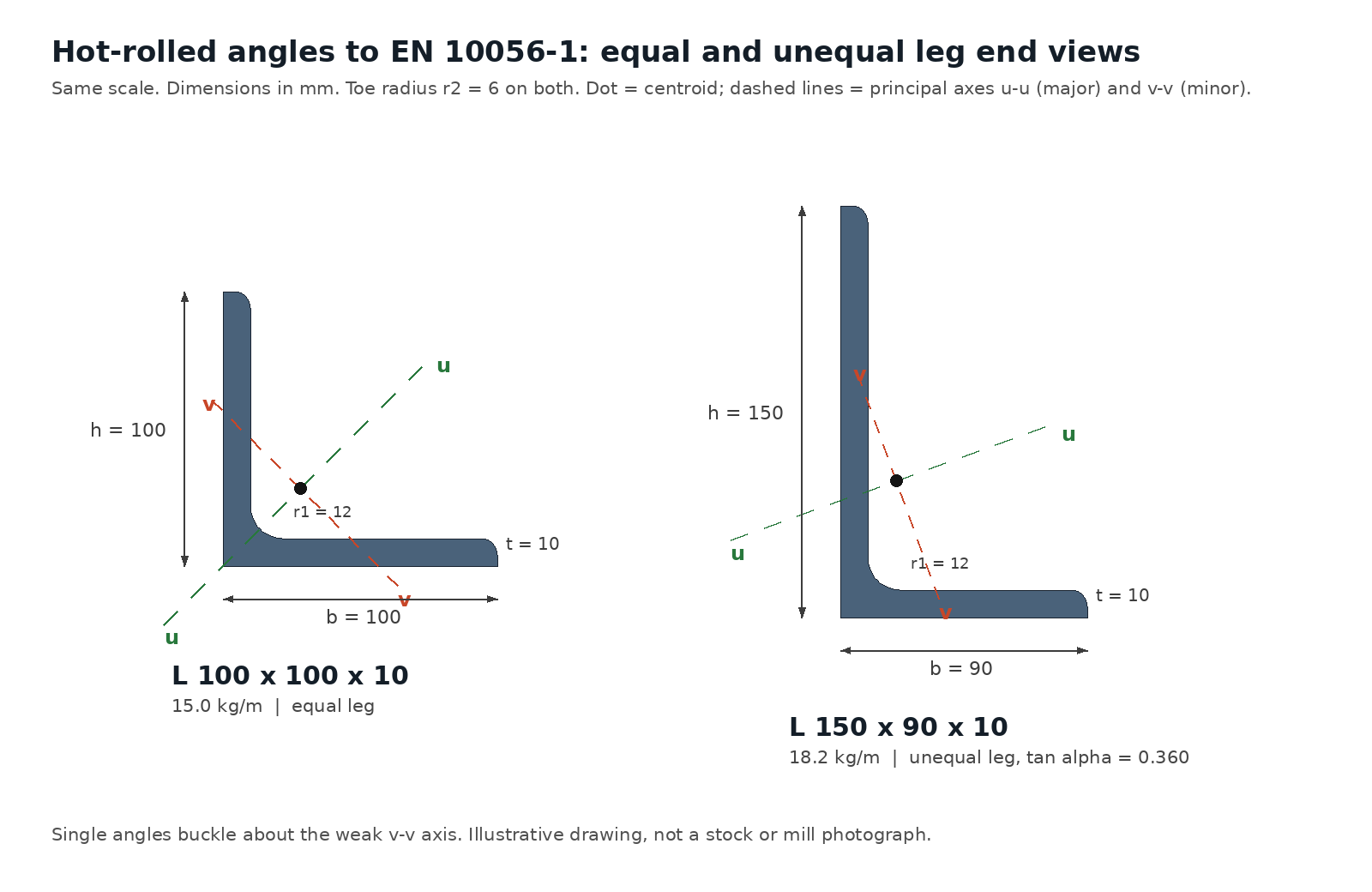
Single angles are usually connected through one leg, so the load is eccentric to the centroid and the member buckles about its weak principal axis v-v, not about the leg axes. For L 100 × 100 × 10, iv is only 1.95 cm against 3.04 cm about y-y. EN 1993-1-1 Annex BB gives effective slenderness rules for angle web members in trusses, and EN 1993-1-8 (clause 3.10.3) reduces the net-section resistance of single angles bolted through one leg. These effects often govern well before the gross squash load is reached, which is why S235JR remains a practical choice for light bracing and secondary members.
Back-to-back double angles with packing plates at intervals behave as a single symmetric section and are common for truss chords and struts; star-battened pairs raise the minor-axis radius further. The heel of an angle against a supporting member gives a clean bearing line for shelf angles and lintels.
S235JR Compared with Other Angle Grades
| Grade | L 100 × 100 × 10 A·ReH | Class of L 100 × 100 × 10 | Equal sizes Class 4 (of 192) |
|---|---|---|---|
| S235JR | about 451 kN | Class 3 | 58 |
| S275JR | about 528 kN | Class 3 | 78 |
| S355JR / S355J2 | about 682 kN gross | Class 4 | 109 |
Fabrication: Bolting, Welding and Galvanizing
S235JR angles weld without preheat in normal conditions. Punching holes in angle legs is common in tower and frame work; whether punching without reaming is allowed depends on the execution class of the fabrication standard. Keep bolt edge and end distances clear of the toe radius and root fillet; the backmark (gauge line) of each leg should come from the detailing data. For galvanizing, small angles are dipped in bundles, so specify straightness requirements after coating if needed.
Delivery Condition, Inspection and Lead Time
| Item | Specify | Reason |
|---|---|---|
| Designation | L h × b × t, e.g. L 150 × 90 × 10 | Leg lengths alone do not fix thickness or mass |
| Delivery condition | +AR or +N where required | Not implied by the grade name |
| Impact test | Whether the 27 J at +20 °C result must be reported, and specimen size for thin legs | Angle legs run from 3 to 35 mm |
| Inspection document | EN 10204 3.1 for heat-specific results | Traceability to the delivered pieces |
| Dimensions | EN 10056-2 tolerances, lengths, cut list | Nominal values are not tolerances |
| Mass basis | Theoretical or weighed | Avoids invoicing disputes |
Lead time: typical delivery is about 35 days for mill orders, and sizes available from stock can ship in 1–3 days. Stock is confirmed size by size at enquiry; the angle tables on this page are reference geometry, not a stock list.
RFQ Checklist
- Full angle designation, quantity and lengths; equal and unequal sizes listed separately.
- EN 10025-2 S235JR, delivery condition and any chemistry options such as the galvanizing silicon range.
- Impact verification and EN 10204 document type.
- Processing: cutting, punching or drilling of legs, notching, galvanizing.
- Packing, marking and destination; whether stock sizes for 1–3 day dispatch are preferred over a mill order.
Other sections in the same grade: EN 10025-2 S235JR HEA and HEB beams, EN 10025-2 S235JR IPE beams and EN 10025-2 S235JR UPE and PFC channels. The hot-rolled steel angle range overview covers angles across grades, gussets and cleat plates are covered by EN 10025-2 S235JR steel plate, and the structural steel sections guide compares all section families.
The same equal and unequal angles in other EN 10025-2 grades: S275JR angles, S355JR angles, S355J2 angles.
Frequently Asked Questions
What angle sizes does this S235JR page cover?
Equal-leg angles from L 25 × 25 × 3 to L 300 × 300 × 35 and unequal-leg angles from L 100 × 65 × 7 to L 250 × 90 × 16. Smaller unequal sizes are also standardised in EN 10056-1 and can be named by full designation on an enquiry.
Which S235JR angles are rated below 235 MPa?
Only legs thicker than 16 mm: L 100 × 100 × 18 and the heavier L 150 to L 300 equal angles. They are rated at 225 MPa. All unequal angles in the table are 16 mm or thinner.
Why are angles only Class 3 or Class 4 and never Class 1?
EN 1993-1-1 gives angles a single compression check: if h/t ≤ 15ε and (b + h)/(2t) ≤ 11.5ε the angle is Class 3, otherwise Class 4. There is no plastic class for angles in compression because their thin outstanding legs buckle locally before full plastic behaviour can develop.
Is L 100 × 100 × 10 slender in S235JR?
No. With h/t = 10 and (b + h)/(2t) = 10, it meets the Class 3 limits at ε = 1.0. The same angle becomes Class 4 in S355 grades.
About which axis does a single S235JR angle buckle?
About the minor principal axis v-v, which is inclined at 45° to the legs for an equal angle. Its radius of gyration iv is much smaller than the leg-axis value, so buckling checks use iv or the effective slenderness rules for angles.
Do S235JR angles need special chemistry for galvanizing?
The grade has no silicon maximum, so order the galvanizing silicon range (0.14–0.25% with P ≤ 0.035%) when angles are to be hot-dip galvanized, to keep the zinc layer within normal thickness.
Can I combine equal and unequal angles on one S235JR order?
Yes. List each designation separately with lengths and quantities; the same EN 10025-2 S235JR certificate structure applies to both.
What is the lead time for S235JR angles?
About 35 days for mill orders; stock sizes can ship in 1–3 days. Each size is confirmed at enquiry.