


Steel Channels
EN 10025-2 S235JR UPE and PFC Channels: Sizes & Data
S235JR Parallel-Flange Channels: What the Order Covers
An S235JR channel from Gangsteel is a hot-rolled parallel-flange U-section, either the metric UPE series or the PFC series, rolled in the lowest-strength EN 10025-2 grade with a +20 °C impact quality. Typical uses are stair stringers, cladding and sheeting rails, trimmers around floor openings, edge members of platforms, machine frames and bracing where the member is sized by stiffness, connection geometry or detailing rather than by strength. Order it as, for example, “UPE 160, EN 10025-2 S235JR” or “PFC 150 × 75 × 18, EN 10025-2 S235JR”.
| Item | Value | Note |
|---|---|---|
| Material | EN 10025-2:2019 S235JR (1.0038) | Impact quality 27 J at +20 °C |
| Section series | UPE and PFC to EN 10365 | Both have parallel inner flange faces; UPN (tapered flange) is a different series |
| Tolerances | EN 10279 | Channel-specific tolerances on dimensions, shape and mass |
| General delivery | EN 10025-1 | Testing, inspection documents, marking |
| Supply | Gangsteel supplies EN 10025-2 S235JR UPE and PFC channels | Sizes, quantities and stock confirmed per enquiry |
| Former designation | St 37-2 (DIN 17100, withdrawn) | Historical only |
UPE Channels in S235JR
| Section | h mm | b mm | tw mm | tf mm | kg/m | ReH MPa | Iy cm⁴ | Wel,y cm³ | Wel,z cm³ | Wel,y·ReH kNm | Class, axial |
|---|---|---|---|---|---|---|---|---|---|---|---|
| UPE 80 | 80 | 50 | 4.0 | 7.0 | 7.9 | 235 | 107 | 26.8 | 8 | 6 | Class 1 |
| UPE 100 | 100 | 55 | 4.5 | 7.5 | 9.8 | 235 | 207 | 41.4 | 11 | 10 | Class 1 |
| UPE 120 | 120 | 60 | 5.0 | 8.0 | 12.1 | 235 | 364 | 60.6 | 14 | 14 | Class 1 |
| UPE 140 | 140 | 65 | 5.0 | 9.0 | 14.5 | 235 | 600 | 85.6 | 18 | 20 | Class 1 |
| UPE 160 | 160 | 70 | 5.5 | 9.5 | 17.0 | 235 | 911 | 114 | 23 | 27 | Class 1 |
| UPE 180 | 180 | 75 | 5.5 | 10.5 | 19.7 | 235 | 1,350 | 150 | 29 | 35 | Class 1 |
| UPE 200 | 200 | 80 | 6.0 | 11.0 | 22.8 | 235 | 1,910 | 191 | 35 | 45 | Class 1 |
| UPE 220 | 220 | 85 | 6.5 | 12.0 | 26.6 | 235 | 2,680 | 244 | 43 | 57 | Class 1 |
| UPE 240 | 240 | 90 | 7.0 | 12.5 | 30.2 | 235 | 3,600 | 300 | 50 | 70 | Class 1 |
| UPE 270 | 270 | 95 | 7.5 | 13.5 | 35.2 | 235 | 5,250 | 389 | 61 | 91 | Class 1 |
| UPE 300 | 300 | 100 | 9.5 | 15.0 | 44.4 | 235 | 7,820 | 522 | 76 | 123 | Class 1 |
| UPE 330 | 330 | 105 | 11.0 | 16.0 | 53.2 | 235 | 11,000 | 667 | 90 | 157 | Class 1 |
| UPE 360 | 360 | 110 | 12.0 | 17.0 | 61.2 | 225 | 14,800 | 824 | 105 | 185 | Class 1 |
| UPE 400 | 400 | 115 | 13.5 | 18.0 | 72.2 | 225 | 21,000 | 1,050 | 123 | 236 | Class 1 |
PFC Channels in S235JR
| Section | h mm | b mm | tw mm | tf mm | kg/m | ReH MPa | Iy cm⁴ | Wel,y cm³ | Wel,z cm³ | Wel,y·ReH kNm | Class, axial |
|---|---|---|---|---|---|---|---|---|---|---|---|
| PFC 100 × 50 × 10 | 100 | 50 | 5.0 | 8.5 | 10.2 | 235 | 208 | 41.5 | 10 | 10 | Class 1 |
| PFC 125 × 65 × 15 | 125 | 65 | 5.5 | 9.5 | 14.8 | 235 | 483 | 77.3 | 19 | 18 | Class 1 |
| PFC 150 × 75 × 18 | 150 | 75 | 5.5 | 10.0 | 17.9 | 235 | 861 | 115 | 27 | 27 | Class 1 |
| PFC 150 × 90 × 24 | 150 | 90 | 6.5 | 12.0 | 23.9 | 235 | 1,160 | 155 | 44 | 36 | Class 1 |
| PFC 180 × 75 × 20 | 180 | 75 | 6.0 | 10.5 | 20.3 | 235 | 1,370 | 152 | 29 | 36 | Class 1 |
| PFC 180 × 90 × 26 | 180 | 90 | 6.5 | 12.5 | 26.1 | 235 | 1,820 | 202 | 47 | 47 | Class 1 |
| PFC 200 × 75 × 23 | 200 | 75 | 6.0 | 12.5 | 23.4 | 235 | 1,960 | 196 | 34 | 46 | Class 1 |
| PFC 200 × 90 × 30 | 200 | 90 | 7.0 | 14.0 | 29.7 | 235 | 2,520 | 252 | 53 | 59 | Class 1 |
| PFC 230 × 75 × 26 | 230 | 75 | 6.5 | 12.5 | 25.7 | 235 | 2,750 | 239 | 35 | 56 | Class 1 |
| PFC 230 × 90 × 32 | 230 | 90 | 7.5 | 14.0 | 32.2 | 235 | 3,520 | 306 | 55 | 72 | Class 1 |
| PFC 260 × 75 × 28 | 260 | 75 | 7.0 | 12.0 | 27.6 | 235 | 3,620 | 278 | 34 | 65 | Class 1 |
| PFC 260 × 90 × 35 | 260 | 90 | 8.0 | 14.0 | 34.8 | 235 | 4,730 | 364 | 56 | 86 | Class 1 |
| PFC 300 × 90 × 41 | 300 | 90 | 9.0 | 15.5 | 41.4 | 235 | 7,220 | 481 | 63 | 113 | Class 1 |
| PFC 300 × 100 × 46 | 300 | 100 | 9.0 | 16.5 | 45.5 | 225 | 8,230 | 549 | 82 | 124 | Class 1 |
| PFC 380 × 100 × 54 | 380 | 100 | 9.5 | 17.5 | 54.0 | 225 | 15,000 | 791 | 89 | 178 | Class 1 |
| PFC 430 × 100 × 64 | 430 | 100 | 11.0 | 19.0 | 64.4 | 225 | 21,900 | 1,020 | 98 | 230 | Class 1 |
Five channel sizes have flanges thicker than 16 mm: UPE 360 (17.0 mm), UPE 400 (18.0 mm), PFC 300 × 100 × 46 (16.5 mm), PFC 380 × 100 × 54 (17.5 mm) and PFC 430 × 100 × 64 (19.0 mm). In S235JR they are rated at 225 MPa; every other UPE and PFC size is rated at 235 MPa. Because ε = 1.0 at 235 MPa, all 14 UPE sizes and all 16 PFC sizes in the tables are Class 1 even in pure compression, so S235JR channels never need effective-section calculations for local buckling.
Wel,y·ReH is the characteristic elastic moment about the major axis using the S235JR yield band for that flange thickness. It is a cross-section value only, with no partial factor, no allowance for lateral-torsional buckling, and no allowance for the torsion that arises whenever a channel is loaded away from its shear centre, so it is not a safe working load. The axial class uses the EN 1993-1-1 limits for internal webs (33/38/42ε) and outstand flanges (9/10/14ε) with ε = √(235/ReH). Under pure major-axis bending every UPE and PFC size in this grade is Class 1. Confirm classification against the design code and national annex for the project.
S235JR Chemistry for Channel Sections
| Element | Limit |
|---|---|
| C | 0.17 |
| Mn | 1.40 |
| Si | no maximum in grade row |
| P | 0.040 |
| S | 0.040 |
| N | 0.012 (waived with total Al ≥ 0.020% or reported N-binding elements) |
| Cu | 0.55 |
| CEV | 0.35 |
With a single CEV maximum of 0.35% and carbon at 0.17% across every channel size, S235JR is the easiest of the four grades to weld. Silicon has no maximum in the grade row; for galvanized stair stringers, rails and frames, order the 0.14–0.25% silicon range with P ≤ 0.035% so the zinc coating does not grow thick and brittle.
S235JR Tensile and Impact Requirements
| Property | tf ≤ 16 mm | 16 mm < tf ≤ 40 mm |
|---|---|---|
| Minimum ReH | 235 MPa | 225 MPa |
| Rm | 360–510 MPa | 360–510 MPa |
| Minimum A (L0 = 5.65√S0) | 26% | 26% |
| Charpy V, minimum | 27 J at +20 °C | 27 J at +20 °C |
| Channels in this band | UPE 80–330; PFC 100 × 50 to 300 × 90 | UPE 360, UPE 400; PFC 300 × 100, 380 × 100, 430 × 100 |
The 27 J requirement is at +20 °C. Most UPE and PFC flanges (7–19 mm) allow at least a 7.5 mm sub-size specimen, but UPE 80 and UPE 100 (7.0 and 7.5 mm flanges) are close to the practical limit. If the impact result must be reported for small channels, agree specimen size in the order.
Designing with S235JR Channels
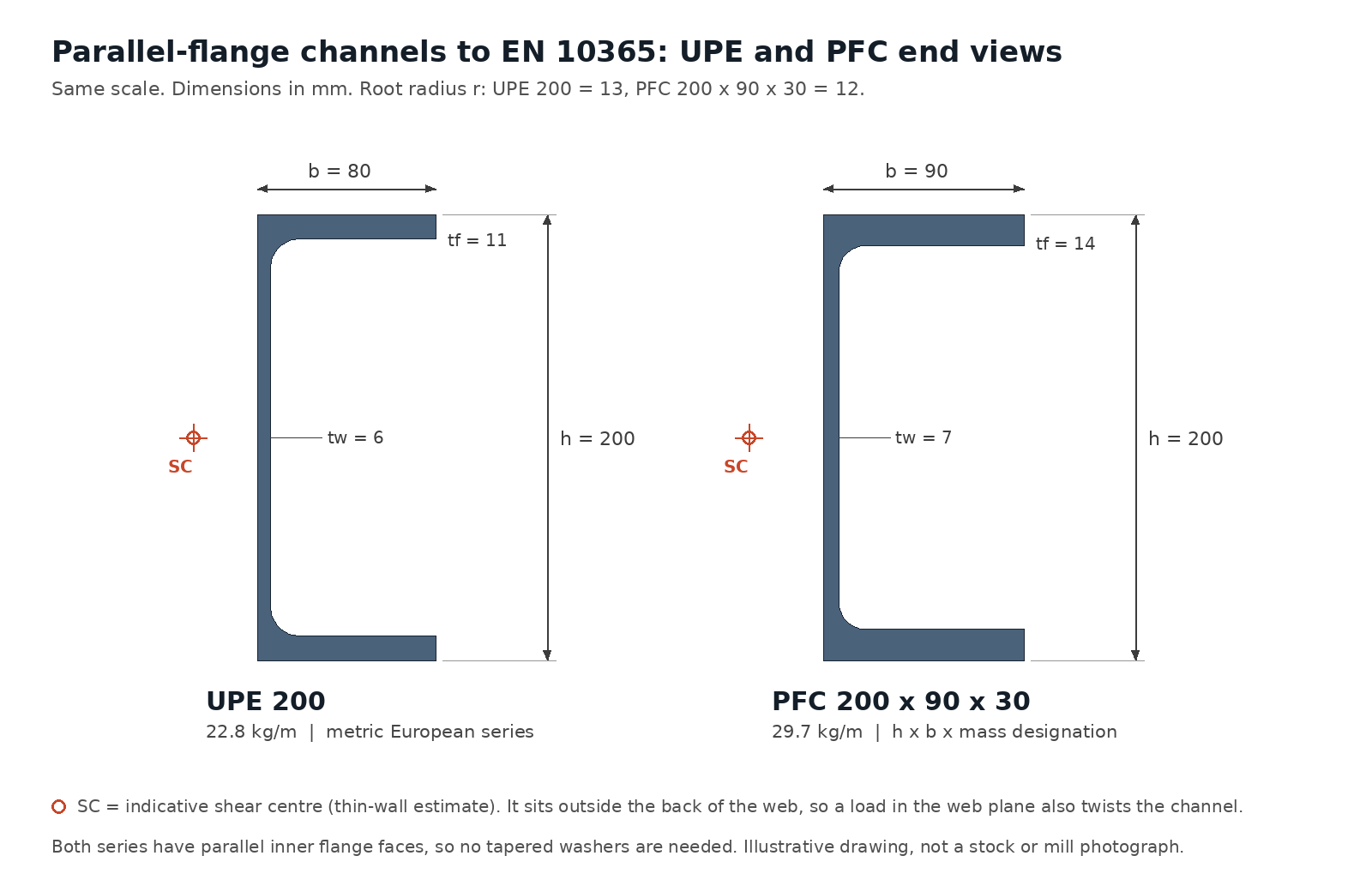
A channel is singly symmetric: its shear centre lies outside the back of the web, as the drawing shows, so a load applied through the web or the flanges also twists the member. For a stair stringer or trimmer this torsion is often restrained by the treads, deck or connections; for a free-standing beam it is not, and the resistance can fall well below Wel,y·ReH. In S235JR that reduction costs little, which is why this grade suits secondary channels. Examples: UPE 200 gives about 45 kNm (191 cm³ × 235 MPa) and PFC 200 × 90 × 30 about 59 kNm, the PFC being heavier (29.7 against 22.8 kg/m) with thicker flanges.
Paired back-to-back channels with a gap for gusset plates make compact truss chords and bracing members; toe-to-toe pairs with batten or lacing plates make built-up columns. Both arrangements remove the torsion problem of a single channel.
S235JR Compared with Other Channel Grades
| Grade | UPE 300 Wel,y·ReH | PFC 300 × 100 × 46 Wel,y·ReH | Difference that matters |
|---|---|---|---|
| S235JR | about 123 kNm | about 124 kNm (225 MPa band) | Lowest CEV (0.35%); all sizes Class 1 |
| S275JR | about 144 kNm | about 145 kNm | Two heaviest PFC become Class 2 in compression |
| S355JR / S355J2 | about 185 kNm | about 189 kNm | Highest strength; several PFC sizes Class 2 or 3 in compression |
Fabrication: Connections, Welding and Coating
S235JR channels weld without preheat in normal conditions; distortion of the thin webs of UPE 80–140 is a bigger risk than cracking, so control heat input and weld sequence. Because the flanges are parallel, HV or ordinary bolts sit on flat washers; no tapered washers are required, unlike UPN. Web holes close to the root radius need the detailing dimensions (end clearance and notch) from the section tables. Galvanize with vent and drain holes in closed built-up members.
Delivery Condition, Inspection and Lead Time
| Item | Specify | Reason |
|---|---|---|
| Series and size | UPE 220 or PFC 230 × 90 × 32, never just “220 channel” | UPE, PFC and UPN of similar depth differ in width, thickness and mass |
| Delivery condition | +AR or +N where required | Not implied by the grade name |
| Impact test | Whether the 27 J at +20 °C result must be reported, and specimen size for thin flanges | Channel flanges are 7–19 mm thick |
| Inspection document | EN 10204 3.1 for heat-specific results | Traceability to the delivered pieces |
| Dimensions | EN 10279 tolerances, lengths, cut list | Nominal values are not tolerances |
| Mass basis | Theoretical or weighed | Avoids invoicing disputes |
Lead time: typical delivery is about 35 days for mill orders, and sizes available from stock can ship in 1–3 days. Stock is confirmed size by size at enquiry; the UPE and PFC tables on this page are reference geometry, not a stock list.
RFQ Checklist
- Series and full designation (UPE or PFC), quantity and lengths.
- EN 10025-2 S235JR, delivery condition and any chemistry options such as the galvanizing silicon range.
- Impact verification and EN 10204 document type.
- Processing: sawing, drilling or punching of web and flanges, blasting, priming, galvanizing.
- Packing, marking and destination; whether stock sizes for 1–3 day dispatch are preferred over a mill order.
Primary members in the same grade are covered by EN 10025-2 S235JR HEA and HEB beams and EN 10025-2 S235JR IPE beams. The parallel flange channel size range and grade overview summarises PFC across grades, gusset and end plates are covered by EN 10025-2 S235JR steel plate, and the structural steel sections guide compares all section families.
The same UPE and PFC channels in other EN 10025-2 grades: S275JR channels, S355JR channels, S355J2 channels.
Frequently Asked Questions
Which UPE and PFC sizes have a lower yield in S235JR?
UPE 360, UPE 400, PFC 300 × 100 × 46, PFC 380 × 100 × 54 and PFC 430 × 100 × 64. Their flanges are 16.5–19.0 mm thick, so they fall in the 16–40 mm band of EN 10025-2 and are rated at 225 MPa instead of 235 MPa.
Is a UPE 200 the same as a PFC 200?
No. Both are 200 mm deep with parallel flanges, but UPE 200 is 80 mm wide with 6.0 mm web and 11.0 mm flanges at 22.8 kg/m, while PFC 200 × 90 × 30 is 90 mm wide with 7.0 mm web and 14.0 mm flanges at 29.7 kg/m. Section properties and connection details differ, so the series must be named on the order.
Why does a single S235JR channel twist under load?
Its shear centre lies behind the web, away from the line of the load. Any load not passing through that point produces torsion in addition to bending. Floor decks, treads, cleats or pairing two channels usually restrain it; an unrestrained single channel has to be checked for torsion and lateral-torsional buckling.
Are any S235JR channels slender in compression?
No. With ε = 1.0 every UPE and PFC size meets the Class 1 limits for the web and the flange outstands in pure compression, and all are Class 1 in major-axis bending as well.
Can S235JR channels be galvanized?
Yes. Specify the silicon range for galvanizing (0.14–0.25% with P ≤ 0.035%) at order stage, and tell the galvanizer the lengths so thin sections can be hung to limit distortion.
Do S235JR channels need preheat for welding?
Normally not. The CEV maximum is 0.35% and the thickest flange is 19 mm, which keeps the risk of hydrogen cracking low. The welding procedure and consumables still follow the fabrication standard used on the project.
When is S235JR the wrong choice for a channel?
When the member is strength-governed and well restrained, or when the structure needs a colder impact temperature. Then S275JR or S355 gives more resistance for the same section, or a J0/J2 quality gives a 0 °C or −20 °C Charpy test.
How are S235JR channels delivered?
In standard mill lengths or cut lengths, bundled by size, with EN 10204 inspection documents as ordered. Typical delivery is about 35 days for a mill order, while stock sizes can ship in 1–3 days after confirmation.