


ABS Steel Plate
ABS FH32 Steel Plate – Properties, Chemistry & Equivalents
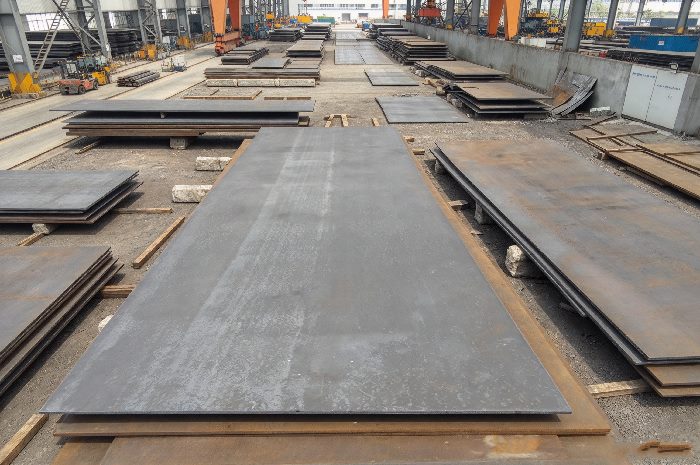
ABS FH32 (also written AB/FH32, ABS Grade FH32, FH32 steel plate) is a higher-strength hull structural steel plate to ABS Rules Part 2, Chapter 1, Section 3. The figure 32 is the strength class (minimum yield 315 MPa, tensile 440-590 MPa) and the letter F sets the Charpy V-notch test temperature of -60°C. It is killed and fine-grain treated, with Nb, V, Ti or Al used as grain refiners, and corresponds to grade F32 in IACS UR W11 and FH32 in ASTM A131.
Related grades: ABS AH32 steel plate ABS DH32 steel plate ABS EH32 steel plate ABS FH36 steel plate.
Gangsteel is specialized in supplying ABS high strength steel plate in ABS Grade FH32. For more information of GradeFH32 steel plate, please check them in following:
AB/FH32 high Strength Chemical Composition
| Element | Heat analysis (max/min) | Product analysis |
|---|---|---|
| C | ≤ 0.16 | ≤ 0.20 |
| Mn | 0.90–1.60 | 0.81–1.72 |
| Si | 0.10–0.50 | 0.04–0.56 |
| P | ≤ 0.025 | ≤ 0.035 |
| S | ≤ 0.025 | ≤ 0.035 |
| Al (acid-soluble) | ≥ 0.015 | — (no tolerance in ASTM A6 Table A; product value not given) |
| Nb | 0.02–0.05 | 0.010–0.060 |
| V | 0.05–0.10 | 0.040–0.110 |
| Ti | ≤ 0.02 | ≤ 0.03 |
| Cu | ≤ 0.35 | ≤ 0.38 |
| Cr | ≤ 0.20 | ≤ 0.24 |
| Ni | ≤ 0.80 | ≤ 0.83 |
| Mo | ≤ 0.08 | ≤ 0.09 |
| N | ≤ 0.009 (≤ 0.012 if Al present) | ≤ 0.014 |
Al, Nb and V minima apply when used singly (combined minima per ABS 2-1-3/5); Si min does not apply where acid-soluble Al ≥ 0.015%; AH ≤ 12.5 mm may have Mn min 0.70%. N product value shown for the 0.009% limit; with Al present the limit is 0.012% (product ≤ 0.017). Product analysis = heat limit ± ASTM A6/A6M Table A permitted variation (band chosen by the specified maximum/upper limit); applies only when product (check) analysis is required; for a range, results may not vary both above and below it. Per ABS Rules for Materials and Welding Part 2 (2022); product analysis tolerances per ABS 2-1-2/5.3 (“chemical tolerances of ASTM A6”) and ASTM A6/A6M 7.2, Table A (also invoked by ASTM A131). Heat limits: ABS 2-1-3/7.3 Table 1 (t ≤ 150 mm).
Crack Sensitivity: Pcm = (C+Si/30+Mn/20+Cu/20+Ni/60+Cr/20+Mo/15+V/10+5B)%
Carbon Equivalent: Ceq = 【C+Mn/6+(Cr+Mo+V)/5+(Ni+Cu)/15】%
AB/FH32 high strength property
| Thickness (mm) | Yield min (MPa) | Tensile (MPa) | Elongation A5 min (%) | Charpy test temp (°C) | Impact avg min, longitudinal (J) | Impact avg min, transverse (J) |
|---|---|---|---|---|---|---|
| t≤50 | 315 | 440-590 | 22 | -60 | 31 | 22 |
| 50<t≤70 | 315 | 440-590 | 22 | -60 | 38 | 26 |
| 70<t≤100 | 315 | 440-590 | 22 | -60 | 46 | 31 |
Source: ABS Rules Pt 2, 2-1-3 Tables 2 & 4. Either direction acceptable.
Boiler steel plates| Alloy steel plates| High strength plate| Carbon steel plate
|
Equivalent steel grade of AB/FH32 |
|||||||
If you need more stock steel plates in shipbuilding steel plate, please click warehouse sizes.
Related steel plates: AB/E,AB/FH36,AB/FH40,AB/EH32
|
General Strength |
||||
|
High Strength |
||||
|
Extra Strength |
||||
ABS FH32 thickness and impact requirements
ABS impact energy rises with plate thickness. ABS FH32 is tested at -60°C. Minimum average energies (full-size specimens):
- t≤50 mm: 31 J longitudinal / 22 J transverse
- 50<t≤70 mm: 38 J longitudinal / 26 J transverse
- 70<t≤100 mm: 46 J longitudinal / 31 J transverse
The ABS tables cover plates up to 150 mm. Plates thicker than 100 mm, or produced from coil, have extra rules in ABS Part 2, Chapter 1, Section 1.
| Standard / society | Equivalent grade |
|---|---|
| ABS | AB/FH32 |
| IACS UR W11 | F32 (also written FH32) |
| ASTM A131 | FH32 |
| DNV | VL F32 |
| LR / BV / CCS / RINA | FH32 |
| NK | KF32 |
| KR | RF32 |
Grades are equivalent in chemistry and properties because the IACS societies use the same unified requirements. A plate still needs a certificate from the vessel's own classification society, so one plate can carry dual or multiple class certification only when each society's surveyor tests it.
FAQ
What does FH32 mean?
The letter F sets the Charpy test temperature (-60°C), and 32 is the strength level: minimum yield 315 MPa.
What are the mechanical properties of ABS FH32?
Minimum yield 315 MPa, tensile strength 440-590 MPa and minimum elongation 22%. Charpy average at -60°C is at least 31 J longitudinal / 22 J transverse for t ≤ 50 mm.
What is the impact test temperature of ABS FH32?
-60°C.
What is ABS FH32 equivalent to?
ASTM A131 FH32, IACS UR W11 grade F32, DNV VL F32, and FH32 under LR, BV, CCS and RINA (NK KF32, KR RF32). The plate still needs a certificate from the vessel's classification society.
What is the chemical composition of ABS FH32?
C ≤ 0.16%, Mn 0.90-1.60%, Si 0.10-0.50%, P and S ≤ 0.025%, and at least one grain refiner (Al ≥ 0.015%, Nb 0.02-0.05% or V 0.05-0.10%). Ni ≤ 0.80%.
How is ABS FH32 supplied?
Depending on thickness and grain refiner: as rolled (thin plates of A and D grades only), normalized, controlled rolled or thermo-mechanically rolled; E and F grades are normalized or TM (QT also allowed for 40 grades). See ABS 2-1-3 Table 5.
ASTM equivalent: ASTM A131 FH32 steel plate
LR equivalent: LR FH32 steel plate
-
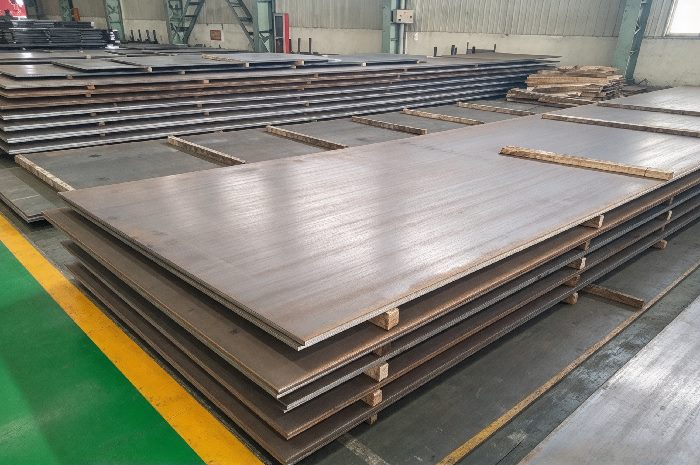
ABS Grade A Plate – Propertie
ABS Grade A ordinary-strength hull plate: chemical composition, 235 MPa yield, 400-520 MPa tensile, Charpy test
-
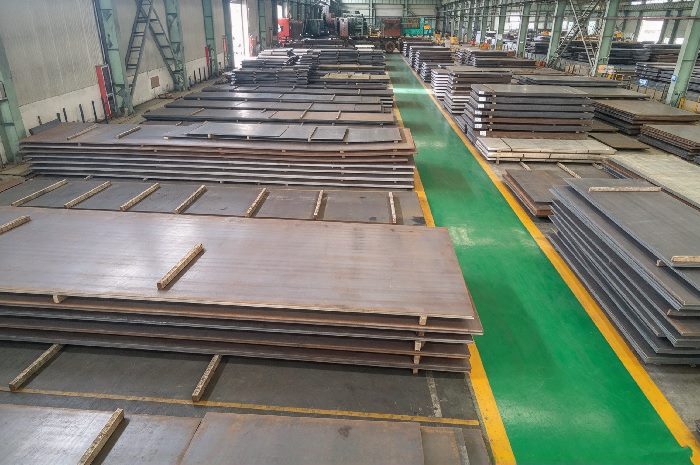
ABS EH36 Steel Plate – Proper
ABS EH36 higher-strength ship plate: 355 MPa min yield, 490-620 MPa tensile, Charpy at -40°C, chemistry table
-
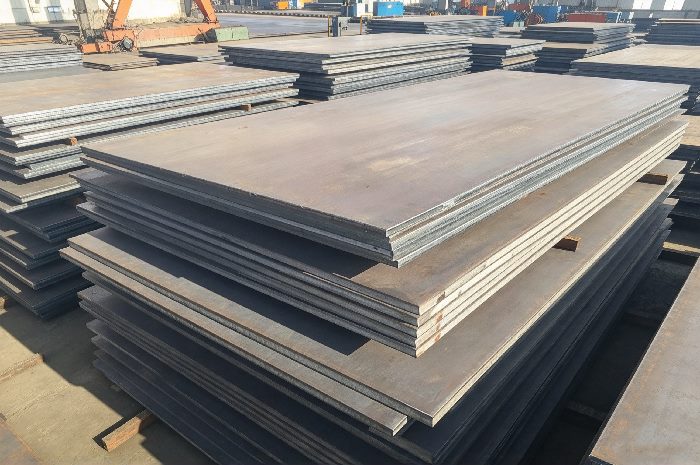
ABS DH36 Steel Plate – Proper
ABS DH36 higher-strength ship plate: 355 MPa min yield, 490-620 MPa tensile, Charpy at -20°C, chemistry table
-
ABS AH36 Steel Plate – Proper
ABS AH36 higher-strength ship plate: 355 MPa min yield, 490-620 MPa tensile, Charpy at 0°C, chemistry table an