


ABS Steel Plate
ABS Grade E Steel Plate – Properties & Equivalents
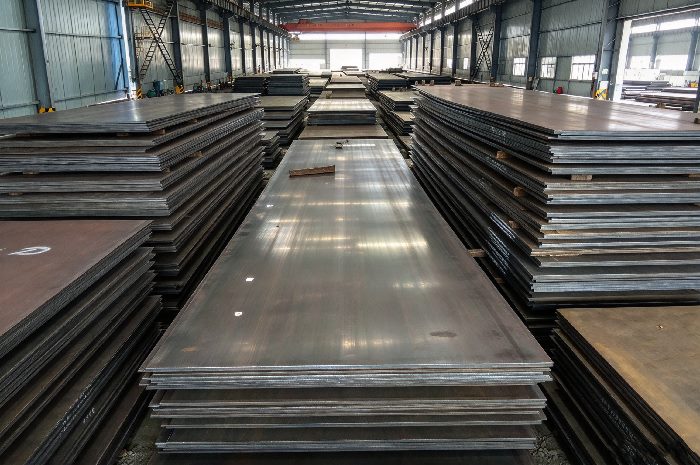
ABS Grade E (also written AB/E, ABS Grade E ship plate) is an ordinary-strength hull structural steel plate certified to the ABS Rules for Materials and Welding, Part 2, Chapter 1, Section 2. All four ordinary grades A, B, D and E share the same strength: minimum yield 235 MPa and tensile strength 400-520 MPa. The grade letter sets the toughness requirement: Grade E is Charpy tested at -40°C and is always killed and fine-grain treated, for areas needing the highest toughness of the ordinary grades. The same grade appears as E in IACS UR W11 and as Grade E in ASTM A131.
Related grades: ABS Grade A steel plate ABS Grade B steel plate ABS Grade D steel plate ABS AH32 steel plate.
Gangsteelis specialized in supplying ABSgeneral strength steel plate in ABS Grade E. For more information of Grade E steel plate, please check them in following:
ABS GRADE E general Strength Chemical Composition
| Element | Heat analysis (max/min) | Product analysis |
|---|---|---|
| C | ≤ 0.18 | ≤ 0.22 |
| Mn | ≥ 0.70 | — (min-only limit; A6 Table A band is keyed to an upper limit, so no product value given) |
| Si | 0.10–0.35 | 0.05–0.40 |
| P | ≤ 0.035 | ≤ 0.045 |
| S | ≤ 0.035 | ≤ 0.045 |
| Al (acid-soluble) | ≥ 0.015 | — (no tolerance in ASTM A6 Table A; product value not given) |
| C + Mn/6 | ≤ 0.40 | — (calculated from heat analysis) |
Si min does not apply where acid-soluble Al ≥ 0.015%. Ni, Cr, Mo and Cu are to be determined and reported (no ABS limit, so no product value). Product analysis = heat limit ± ASTM A6/A6M Table A permitted variation (band chosen by the specified maximum/upper limit); applies only when product (check) analysis is required; for a range, results may not vary both above and below it. Per ABS Rules for Materials and Welding Part 2 (2022); product analysis tolerances per ABS 2-1-2/5.3 (“chemical tolerances of ASTM A6”) and ASTM A6/A6M 7.2, Table A (also invoked by ASTM A131). Heat limits: ABS 2-1-2/15.9 Table 1 (t ≤ 150 mm).
Crack Sensitivity: Pcm = (C+Si/30+Mn/20+Cu/20+Ni/60+Cr/20+Mo/15+V/10+5B)%
Carbon Equivalent: Ceq = 【C+Mn/6+(Cr+Mo+V)/5+(Ni+Cu)/15】%
ABS GRAD E generalstrength property
| Thickness (mm) | Yield min (MPa) | Tensile (MPa) | Elongation A5 min (%) | Charpy test temp (°C) | Impact avg min, longitudinal (J) | Impact avg min, transverse (J) |
|---|---|---|---|---|---|---|
| t≤50 | 235 | 400-520 | 22 | -40 | 27 | 20 |
| 50<t≤70 | 235 | 400-520 | 22 | -40 | 34 | 24 |
| 70<t≤100 | 235 | 400-520 | 22 | -40 | 41 | 27 |
Source: ABS Rules Pt 2, 2-1-2 Tables 2 & 4. Either direction acceptable.
Boiler steel plates| Alloy steel plates| High strength plate| Carbon steel plate
|
Equivalent steel grade of ABS GRADE E |
|||||||
If you need more stock steel plates in shipbuilding steel plate, please click warehouse sizes.
Related steel grades: AB/D, AB/B, AB/A, AB/EH32
|
General Strength |
||||
|
High Strength |
||||
|
Extra Strength |
||||
ABS Grade E thickness and impact requirements
ABS impact energy rises with plate thickness. ABS Grade E is tested at -40°C. Minimum average energies (full-size specimens):
- t≤50 mm: 27 J longitudinal / 20 J transverse
- 50<t≤70 mm: 34 J longitudinal / 24 J transverse
- 70<t≤100 mm: 41 J longitudinal / 27 J transverse
The ABS tables cover plates up to 150 mm. Plates thicker than 100 mm, or produced from coil, have extra rules in ABS Part 2, Chapter 1, Section 1.
| Standard / society | Equivalent grade |
|---|---|
| ABS | AB/E |
| IACS UR W11 | E |
| ASTM A131 | Grade E |
| DNV | VL E |
| LR / BV / CCS / RINA | E |
| NK | KE |
| KR | RE |
Grades are equivalent in chemistry and properties because the IACS societies use the same unified requirements. A plate still needs a certificate from the vessel's own classification society, so one plate can carry dual or multiple class certification only when each society's surveyor tests it.
FAQ
What is ABS Grade E steel?
ABS Grade E is an ordinary-strength hull structural steel with a minimum yield of 235 MPa and a tensile strength of 400-520 MPa, certified to ABS Rules Part 2, Chapter 1, Section 2.
What is the impact test temperature for ABS Grade E?
-40°C. The minimum average energy is 27 J longitudinal / 20 J transverse for plates up to 50 mm, and rises with thickness.
What is the chemical composition of ABS Grade E?
Ladle analysis: C ≤ 0.18%, Mn ≥0.70%, Si 0.10-0.35%, P and S ≤ 0.035%, and C + Mn/6 ≤ 0.40%.
What is ABS Grade E equivalent to?
Grade E in ASTM A131, grade E in IACS UR W11, and VL E at DNV. LR, BV, CCS, NK (KE) and KR (RE) list the same grade. The class certificate must match the vessel's society.
What is the minimum elongation of ABS Grade E?
22% on the ABS standard (alternative A) specimen. For 200 mm gauge flat specimens the minimum depends on thickness (14-22%).
ASTM equivalent: ASTM A131 Grade E steel plate
LR equivalent: LR Grade E steel plate
-
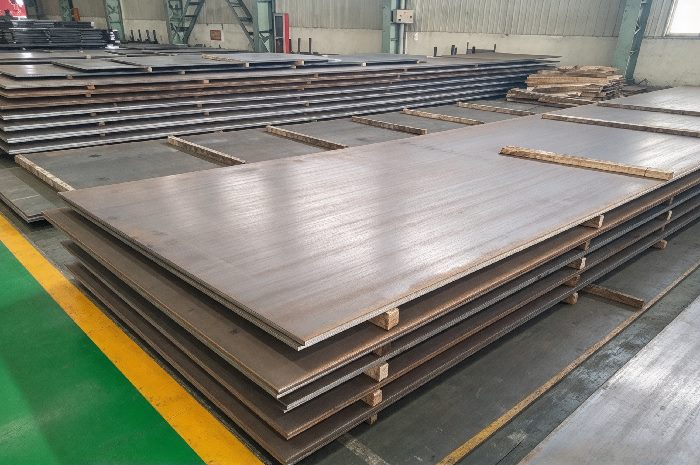
ABS Grade A Plate – Propertie
ABS Grade A ordinary-strength hull plate: chemical composition, 235 MPa yield, 400-520 MPa tensile, Charpy test
-
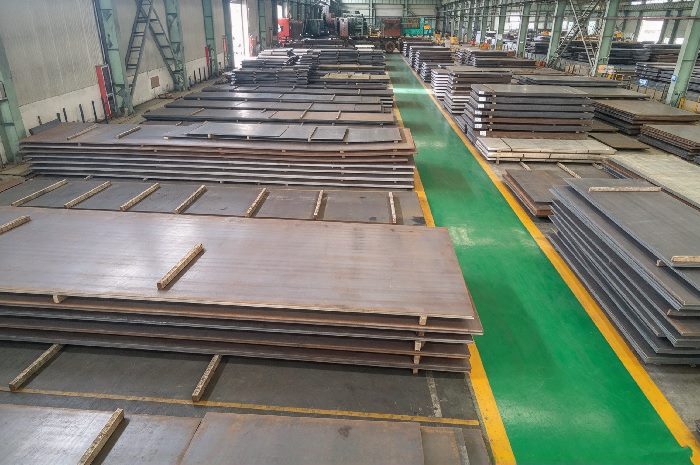
ABS EH36 Steel Plate – Proper
ABS EH36 higher-strength ship plate: 355 MPa min yield, 490-620 MPa tensile, Charpy at -40°C, chemistry table
-
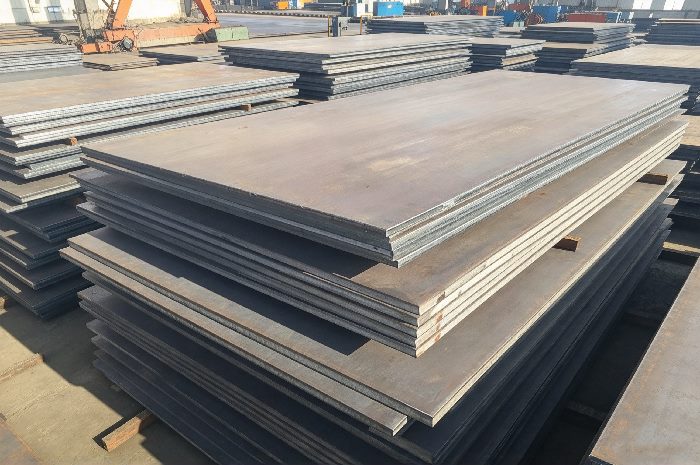
ABS DH36 Steel Plate – Proper
ABS DH36 higher-strength ship plate: 355 MPa min yield, 490-620 MPa tensile, Charpy at -20°C, chemistry table
-
ABS AH36 Steel Plate – Proper
ABS AH36 higher-strength ship plate: 355 MPa min yield, 490-620 MPa tensile, Charpy at 0°C, chemistry table an